This is chapter 4 of the Kartik Mahatmya, told by Devarshi Narada. A tiny fish grows beyond all measure and turns out to be Lord Vishnu as Matsya. He slays Shankhasura, the rishis recover the scattered Vedas, and Prayag becomes Tirtharaj, the king of pilgrimages.
Listen in the video: hear this chapter in Hindi on our YouTube channel. The full list is on the Kartik Mahatmya Katha page.
संक्षेप में: कश्यप जी की अंजलि में गिरी छोटी मछली स्वयं भगवान विष्णु थे। शंखासुर वध, वेदों का उद्धार और तीर्थराज प्रयाग की कथा। पूरा लेख हिंदी में पढ़ें →
The story
Maharshi Kashyap was doing tapasya on the Vindhyachal mountain. He had taken water in his cupped hands to offer arghya to the Sun when a tiny fish dropped from the sky into his palms. Moved by pity, he put it in his kamandal. Almost at once the fish grew too big for it.
He moved it to a well, and it outgrew the well. He moved it to a pond, and it outgrew the pond. At last he released it into the ocean, and even there it kept growing. The sage understood that this was no ordinary fish. It was Lord Vishnu himself, in the form of Matsya.
In the depths of the ocean Matsya fought a terrible battle with Shankhasura. Huge waves rose across the sea, and in the end the Lord slew the demon. But the Vedas lay scattered through the waters. The Lord carried Shankhasura's body to Badrivan and called all the rishis. He told them to find the mantras scattered in the water and bring them quickly, while he waited with the gods at Prayag.
By the strength of their tapas the rishis drew out the Vedas, the yajnas and the bija mantras. Whichever rishi found a mantra came to be known as the rishi of that mantra. They gathered at Prayag and handed everything to Brahma and Lord Vishnu. Brahma was overjoyed to have the Vedas back, and with the gods and rishis he performed an Ashwamedha yajna at Prayag.
After the yajna the gods prayed that this place might become the holiest tirtha on earth, that gifts made here might never perish, and that even the gravest sins of those who came here might be washed away. The Lord said, so be it. The place would be called Brahmakshetra and later Tirtharaj Prayag. King Bhagirath of the Solar line would bring the Ganga here, and here she would meet the Yamuna, daughter of the Sun.
The Lord said that a mere sight of Tirtharaj destroys sin, and that bathing here in the month of Magh, when the Sun is in Makar, carries a person to his own realm. Then Lord Vishnu vanished with Brahma, and Indra and the other gods returned to their worlds.
Narada closed by telling King Prithu that the Lord dwells in water during Kartik, and that the Kartik bath gives the fruit of all the tirthas. He added that one who worships Sri Hari at the root of the tulsi in Kartik enjoys happiness in this world and at the end goes to Vaikuntha.
The teaching of this chapter
Kashyap's fish looked like nothing much. He cared for it out of simple pity, and it was the Lord himself. This chapter ends on an act just as small. Light a lamp of ghee near the root of the tulsi in the evening and remember Sri Hari.
Frequently asked questions
How did Kashyap realise the fish was divine?
It outgrew his kamandal, a well, a pond and then kept growing even in the ocean. He understood that it was Lord Vishnu in the form of Matsya.
Who recovered the Vedas after Shankhasura was slain?
The rishis did. The Lord called them to Badrivan, and by the strength of their tapas they drew the Vedas, yajnas and bija mantras out of the water.
How did Prayag become Tirtharaj?
After Brahma's Ashwamedha there, the gods prayed that it become the holiest tirtha on earth, and the Lord granted it.
What does the chapter say about Prayag in Magh?
The Lord says that bathing there in the month of Magh, when the Sun is in Makar, carries a person to his realm.
What does Narada say about the Kartik bath?
He says that it gives the fruit of all the tirthas, because the Lord dwells in water during Kartik.
Previous chapter: Adhyay 3: Why Kartik Is Best and the Theft of the Vedas
Next chapter: Adhyay 5: The Vrati's Day and Where God Lives
 SpiritualityKartik Mahatmya Adhyay 7: The Rules of the Kartik Vow
 SpiritualityKartik Mahatmya Adhyay 8: The Udyapan of the Kartik Vow
 SpiritualityKartik Mahatmya Adhyay 6: The Method and Merit of the Kartik Bath
 SpiritualityKartik Mahatmya Adhyay 5: The Vrati's Day and Where God Lives
 SpiritualityKartik Maas Ki Kahani: Budhiya Mai and the Khichdi Bowl
 SpiritualityKartik Mahatmya Katha 2026: All Chapters, Daily Calendar and Videos
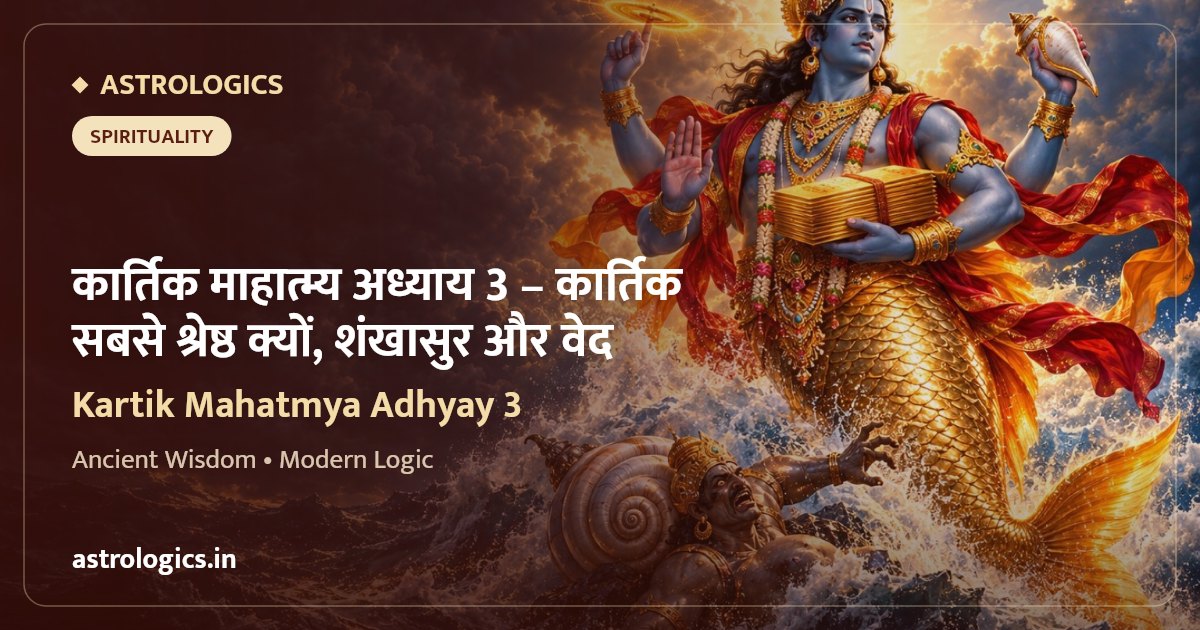 SpiritualityKartik Mahatmya Adhyay 3: Why Kartik Is Best and the Theft of the Vedas
 SpiritualityKartik Mahatmya Adhyay 1 and 2: Gunavati and Satyabhama's Past Life