Shri Surya Mandala Ashtakam: Stotra of the Sun's Radiant Orb
Shri Surya Mandala Ashtakam - Sanskrit Text
॥ श्रीसूर्यमण्डलाष्टकम् ॥
नमः सवित्रे जगदेकचक्षुषे
जगत्प्रसूतिस्थितिनाशहेतवे ।
त्रयीमयाय त्रिगुणात्मधारिणे
विरञ्चिनारायणशङ्करात्मने ॥१॥
यन्मण्डलं दीप्तिकरं विशालं
रत्नप्रभं तीव्रमनादिरूपम् ।
दारिद्र्यदुःखक्षयकारणं च
पुनातु मां तत्सवितुर्वरेण्यम् ॥२॥
यन्मण्डलं देवगणैः सुपूजितं
विप्रैः स्तुतं भावनमुक्तिकोविदम् ।
तं देवदेवं प्रणमामि सूर्यं
पुनातु मां तत्सवितुर्वरेण्यम् ॥३॥
यन्मण्डलं ज्ञानघनं त्वगम्यं
त्रैलोक्यपूज्यं त्रिगुणात्मरूपम् ।
समस्ततेजोमयदिव्यरूपं
पुनातु मां तत्सवितुर्वरेण्यम् ॥४॥
यन्मण्डलं गूढमतिप्रबोधं
धर्मस्य वृद्धिं कुरुते जनानाम् ।
यत्सर्वपापक्षयकारणं च
पुनातु मां तत्सवितुर्वरेण्यम् ॥५॥
यन्मण्डलं व्याधिविनाशदक्षं
यदृग्यजुः सामसु संप्रगीतम् ।
प्रकाशितं येन च भूर्भुवः स्वः
पुनातु मां तत्सवितुर्वरेण्यम् ॥६॥
यन्मण्डलं वेदविदो वदन्ति
गायन्ति यच्चारणसिद्धसंघाः ।
यद्योगिनो योगजुषां च संघाः
पुनातु मां तत्सवितुर्वरेण्यम् ॥७॥
यन्मण्डलं सर्वजनेषु पूजितं
ज्योतिश्च कुर्यादिह मर्त्यलोके ।
यत्कालकल्पक्षयकारणं च
पुनातु मां तत्सवितुर्वरेण्यम् ॥८॥
यन्मण्डलं विश्वसृजां प्रसिद्ध-
मुत्पत्तिरक्षाप्रलयप्रगल्भम् ।
यस्मिञ्जगत्संहरतेऽखिलं च
पुनातु मां तत्सवितुर्वरेण्यम् ॥९॥
यन्मण्डलं सर्वगतस्य विष्णोर्
आत्मा परं धाम विशुद्धतत्त्वम् ।
सूक्ष्मान्तरैर्योगपथानुगम्यं
पुनातु मां तत्सवितुर्वरेण्यम् ॥१०॥
यन्मण्डलं वेदविदो वदन्ति
गायन्ति यच्चारणसिद्धसंघाः ।
यन्मण्डलं वेदविदः स्मरन्ति
पुनातु मां तत्सवितुर्वरेण्यम् ॥११॥
यन्मण्डलं वेदविदोपगीतं
यद्योगिनां योगपथानुगम्यम् ।
तत्सर्ववेदं प्रणमामि सूर्यं
पुनातु मां तत्सवितुर्वरेण्यम् ॥१२॥
मण्डलाष्टतयं पुण्यं
यः पठेत्सततं नरः ।
सर्वपापविशुद्धात्मा
सूर्यलोके महीयते ॥१३॥
॥ इति श्रीमदादित्यहृदये मण्डलाष्टकं सम्पूर्णम् ॥
Transliteration (Roman/IAST)
namaḥ savitre jagad-eka-cakṣuṣe
jagat-prasūti-sthiti-nāśa-hetave ।
trayī-mayāya tri-guṇātma-dhāriṇe
viriñci-nārāyaṇa-śaṅkarātmane ॥1॥
yan-maṇḍalaṃ dīpti-karaṃ viśālaṃ
ratna-prabhaṃ tīvram-anādi-rūpam ।
dāridrya-duḥkha-kṣaya-kāraṇaṃ ca
punātu māṃ tat-savitur-vareṇyam ॥2॥
(The refrain "punātu māṃ tat-savitur-vareṇyam" - "may that adorable orb of Savitr purify me" - closes each of the eight central verses.)
Meaning
Salutations to Savitr, the one eye of the world, the cause of the universe's birth, sustenance and dissolution, who is made of the three Vedas, who holds the three gunas, and whose very self is Brahma (Virinchi), Vishnu (Narayana) and Shiva (Shankara).
The hymn then meditates, verse by verse, on the radiant orb (mandala) of the Sun: vast and brilliant, jewel-bright and beginningless; the destroyer of poverty and sorrow; worshipped by the gods and praised by the wise; dense with knowledge and beyond reach; promoter of dharma and destroyer of all sin; healer of disease; sung in the Rig, Yajur and Sama Vedas; the orb by which the three worlds (bhuh, bhuvah, svah) are illumined; the supreme abode and pure essence of the all-pervading Vishnu, reached only by yogis on the subtle path. Each verse ends with the prayer: "May that adorable orb of Savitr purify me." The final verse promises that one who recites this eightfold hymn of the orb becomes purified of all sins and is exalted in the realm of the Sun.
About this Stotra
The Surya Mandala Ashtakam is drawn from the Aditya Hridaya, the celebrated hymn to the Sun that the sage Agastya taught Lord Rama before his battle with Ravana. Its theme is the mandala - the luminous solar disc - understood not merely as a physical object but as the visible form of the Supreme. The word "ashtakam" (eightfold) refers to the eight central meditative verses, framed by an opening salutation and a concluding phala-shruti (statement of benefits). The repeated refrain, echoing the Gayatri's "tat savitur varenyam," anchors the whole hymn in the most sacred Vedic adoration of the Sun.
Significance & Spiritual Benefits
The Sun in the Vedic tradition is the visible deity (pratyaksha devata) and the source of all life, light and consciousness. This stotra is recited for purification of body and mind, removal of poverty and disease, growth of dharma and merit, and the destruction of sins. Because it identifies the solar orb with the supreme reality and the abode of Vishnu, it is also a meditation leading toward liberation (the worshipper is "exalted in Suryaloka"). Devotees recite it for health, vitality, mental clarity, prosperity and protection.
Astrological Relevance
This is one of the foremost remedial hymns for Surya (the Sun) in Vedic astrology. The Sun is the karaka of the soul (atma), vitality, health, bones, the father, government, authority, leadership and reputation. A weak, debilitated, combust or afflicted Sun can manifest as low confidence, ill health, eye and bone problems, trouble with authority or father, and lack of recognition. Regular recitation of the Surya Mandala Ashtakam - ideally at sunrise while offering arghya (water) to the Sun - is a classical upaya to strengthen the Sun, enhance ojas and tejas (vital lustre), and bless the devotee with health, success and standing. It is especially valued during Surya-related dashas, and the hymn is a natural companion to Chhath Puja, Ratha Saptami and Sunday Surya worship.
How to Chant (Vidhi)
Rise before dawn, bathe, and face east toward the rising Sun. Offer arghya by pouring water from a copper vessel while looking at the Sun through the falling stream, then recite the Surya Mandala Ashtakam with devotion. It may be chanted once or in multiples; some recite it daily as part of Surya Namaskar or the morning Sandhya. Use a copper vessel, red flowers and, if possible, add a pinch of red sandalwood or roli to the offered water. Conclude with prostration to Surya Deva.
Best Day & Time
Sunday (Ravivar), the day of the Sun, is most auspicious, as is sunrise on any day - the moment the Sun's orb first appears. Special occasions include Ratha Saptami, Makar Sankranti and Chhath Puja. Recitation at the time of offering arghya at dawn carries the greatest benefit.
Frequently Asked Questions
What is the meaning of "punatu mam tat savitur varenyam"?
It means "May that adorable (varenyam) orb of Savitr (the Sun) purify (punatu) me." The phrase echoes the Gayatri mantra and forms the refrain that closes each of the eight central verses.
Where does the Surya Mandala Ashtakam come from?
It is part of the Aditya Hridaya tradition - the hymn to the Sun that the sage Agastya imparted to Lord Rama before his battle with Ravana, as related in the Ramayana.
How does this stotra help with astrology?
It is a remedial hymn for the Sun (Surya graha). Reciting it, especially while offering water to the rising Sun on Sundays, is believed to strengthen a weak or afflicted Sun and bless the devotee with health, confidence, vitality and recognition.
Meditating on the sun as the eye of the cosmos
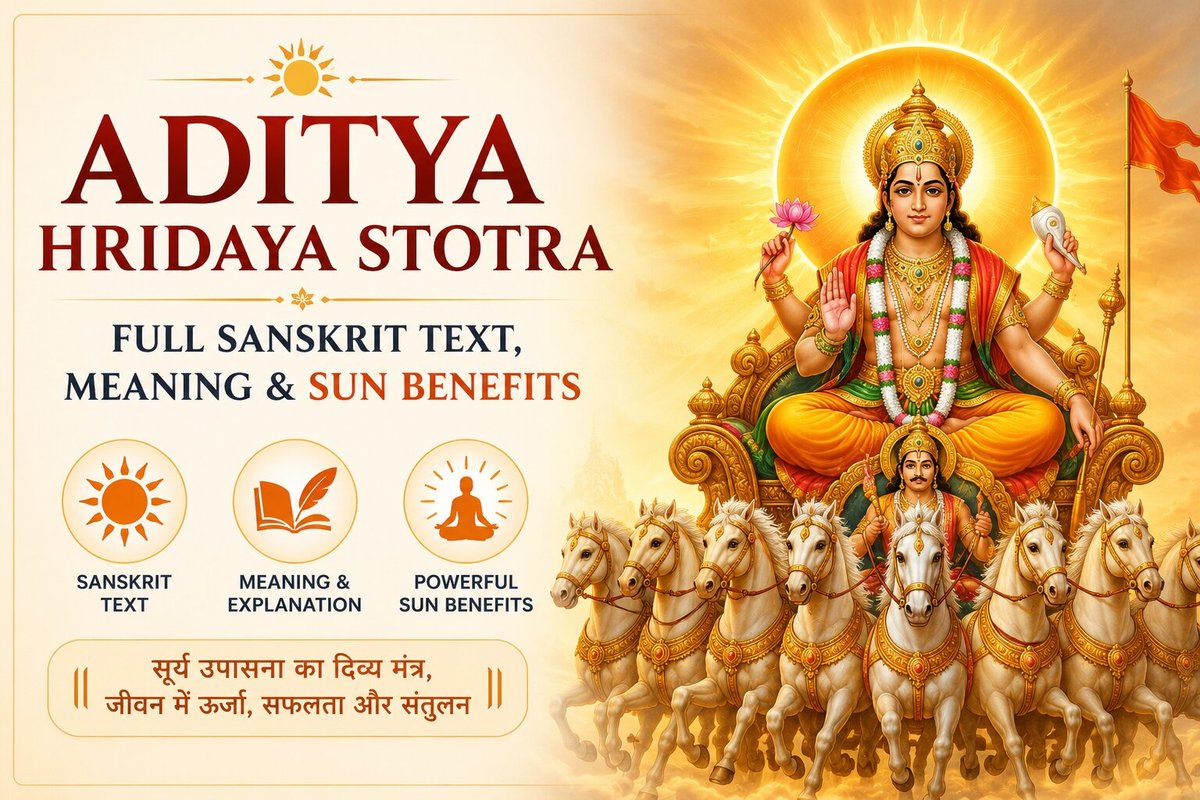
The Surya Mandala Ashtakam brings to focus a specific and profound dimension of solar devotion: it is not Surya the deity who is praised so much as Surya the mandala - the sacred orb itself, the blazing disc that the Vedic seers described as the single eye of the universe, the source from which creation springs and into which it ultimately returns. Each of the eight verses circles that luminous orb with wonder and prayer, asking that it purify the worshipper as surely as it illuminates the world. This meditative, visually concentrated approach to Surya worship gives the ashtakam a quality closer to dhyana than to conventional eulogy.
In the Jyotish tradition, the Sun (Surya) is the Atmakaraka - the significator of the soul - and a strong, well-placed Sun in the natal chart is associated with clarity of identity, vitality, leadership and the grace to fulfil one's dharma. Reciting the Surya Mandala Ashtakam at sunrise on Sundays, or during Ratha Saptami, is considered by devotees to be a particularly potent practice for strengthening Surya's positive influence, supporting health and bringing inner radiance. The image at the heart of the text - the solar disc as the eye through which the cosmos sees itself - is one that rewards slow, contemplative recitation far more than hurried reading.