Hey Govind Hey Gopal Rakho Sharan – Lyrics, Meaning & Significance
Hey Govind Hey Gopal Lyrics (हिंदी में)
हे गोविन्द राखो शरण, अब तो जीवन हारे ॥
नीर पिवन हेतु गयो, सिन्धु के किनारे,
सिन्धु बीच बसत ग्राह, चरण धरि पछारे ।
हे गोविन्द राखो शरण, अब तो जीवन हारे ॥
चार प्रहर युद्ध भयो, ले गयो मझधारे,
नाक कान डूबन लागे, कृष्ण को पुकारे ।
हे गोविन्द राखो शरण, अब तो जीवन हारे ॥
द्वारका में सबद दयो, शोर भयो द्वारे,
शंख चक्र गदा पद्म, गरुड़ तजि सिधारे ।
हे गोविन्द राखो शरण, अब तो जीवन हारे ॥
सूर कहे श्याम सुनो, शरण हम तिहारे,
अबकी बेर पार करो, नन्द के दुलारे ।
हे गोविन्द राखो शरण, अब तो जीवन हारे ॥
Hey Govind Hey Gopal – Transliteration (English)
He Govind rakho sharan, ab to jivan hare ||
Neer pivan hetu gayo, sindhu ke kinare,
Sindhu beech basat graah, charan dhari pachhare |
He Govind rakho sharan, ab to jivan hare ||
Chaar prahar yuddh bhayo, le gayo majhdhare,
Naak kaan duban lage, Krishna ko pukare |
He Govind rakho sharan, ab to jivan hare ||
Dwaraka mein sabad dayo, shor bhayo dware,
Shankh chakra gada padma, Garud taji sidhare |
He Govind rakho sharan, ab to jivan hare ||
Sur kahe Shyam suno, sharan hum tihare,
Abki ber paar karo, Nand ke dulare |
He Govind rakho sharan, ab to jivan hare ||
Meaning & Significance
This bhajan narrates the celebrated episode of Gajendra Moksha - the liberation of the elephant king Gajendra - drawn from the Bhagavata Purana (Book 8, Chapters 2–4). The elephant Gajendra, while drinking from a great lake, was seized by a powerful crocodile (graah) that grabbed his leg and refused to release him. A fierce struggle lasted four praharas (approximately twelve hours), until Gajendra, exhausted and sinking beneath the water, called out to Lord Vishnu-Krishna in total surrender. The bhajan recreates this moment of complete helplessness with heart-rending simplicity: Protect me, O Govind - my life is lost. Upon hearing Gajendra's cry, the Lord immediately abandoned all royal protocol - dropping conch, discus, mace, and lotus, even abandoning his eagle-mount Garuda - and rushed barefoot from Dwaraka to rescue his devotee. The story is one of the most beloved illustrations of sharanagati (total surrender to God) in the Vaishnava tradition. The closing signature Sur kahe (Surdas says) and the address to Krishna as Nand ke dulare (the beloved of Nanda) confirm the traditional attribution to the blind poet-saint Surdas.
About the Composer
Surdas (circa 1478–1583 CE) was a blind bhakti poet of the Braj region (around Mathura and Vrindavan) and one of the greatest composers in the Vaishnava Saguna tradition. A devotee of Krishna and a disciple of the philosopher-saint Vallabhacharya, Surdas composed hundreds of thousands of padas (verse compositions) in Braj Bhasha, collected in the monumental Sur Sagar (Ocean of Sur). His compositions are characterised by exquisite lyrical beauty, vivid evocation of Krishna's childhood in Vrindavan, and a passionate intensity of devotion. Though blind from birth (according to hagiographical tradition), Surdas is said to have seen Krishna more clearly than the sighted, and his poetry is renowned for its sensory richness and emotional depth. He remains one of the Ashtachhap - the eight principal poets of the Vallabha sampradaya.
About Krishna (Govind, Gopal)
Lord Krishna - worshipped as Govind (he who delights the cows and the senses), Gopal (the cowherd and protector of cows), and Shyam (the dark-complexioned one) - is one of the most beloved and widely worshipped deities in Hinduism. As the eighth avatar of Vishnu, Krishna is simultaneously the playful cowherd of Vrindavan, the divine teacher of the Bhagavad Gita, and the universal protector who responds immediately to the sincere cry of any surrendered devotee. His role in the Gajendra Moksha story epitomises the Vaishnava teaching of instant divine grace: no ritual is needed, no formula, only a cry of genuine surrender. Govind and Gopal are especially beloved names in bhakti poetry, evoking Krishna's closeness, tenderness, and total availability to the devotee.
Spiritual Significance & Benefits
- This bhajan is a meditation on sharanagati - total surrender to God - considered the highest spiritual practice in the Vaishnava tradition.
- The story of Gajendra teaches that divine grace is not proportional to one's spiritual accomplishment but is available to whoever calls sincerely, even an elephant in a swamp.
- Reciting or singing this bhajan cultivates the quality of genuine helplessness before the divine - the opening of the heart that invites grace.
- The image of Krishna abandoning all divine paraphernalia to rush to Gajendra's side offers profound reassurance of God's unconditional love for the devoted soul.
- Regular practice deepens trust (vishwas) in divine protection, especially in moments of personal crisis or overwhelm.
When & How It Is Sung
Hey Govind Hey Gopal is sung in the bhajan tradition of North India, particularly in satsangs and classical vocal performances. It has been rendered by many celebrated vocalists, including M. S. Subbulakshmi, Anup Jalota, and Lakshmi Shankar, in multiple classical ragas. It is especially appropriate for Ekadashi (the eleventh lunar day, sacred to Vishnu), Janmashtami (Krishna's birthday), and other Vaishnava observances. The bhajan's narrative structure - each verse advancing the story of Gajendra - makes it naturally engaging for both devotional and musical settings.
Frequently Asked Questions
Who is Gajendra, and what is Gajendra Moksha?
Gajendra is the elephant king described in the Bhagavata Purana. In a former life he was a human king who was cursed to be born as an elephant. When a powerful crocodile seized him in a lake, Gajendra's physical struggles proved futile, and in his total helplessness he called out to Vishnu-Krishna with a beautiful hymn of surrender. The Lord immediately appeared and liberated him from the crocodile's grip, simultaneously granting Gajendra moksha - liberation from the cycle of birth and death.
What does Govind mean?
Govind (or Govinda) is a name of Krishna meaning he who pleases the cows (go = cow, vinda = one who finds or pleases) or he who delights the senses. In the broader philosophical tradition, it also means the one who is known through the senses or the lord of the cosmic sense-world. As a name it evokes Krishna's pastoral, intimate aspect as the cowherd of Vrindavan.
What is the devotional lesson of this bhajan?
The central lesson is that complete surrender (sharanagati) - total acknowledgment of one's own limitations and full trust in divine grace - is both the highest spiritual practice and the most powerful prayer. Gajendra's cry was not a technically perfect mantra but a cry of genuine need and trust. The Lord's response - dropping everything and racing barefoot - teaches that God's love for the surrendered devotee transcends all divine protocol and is unconditional.
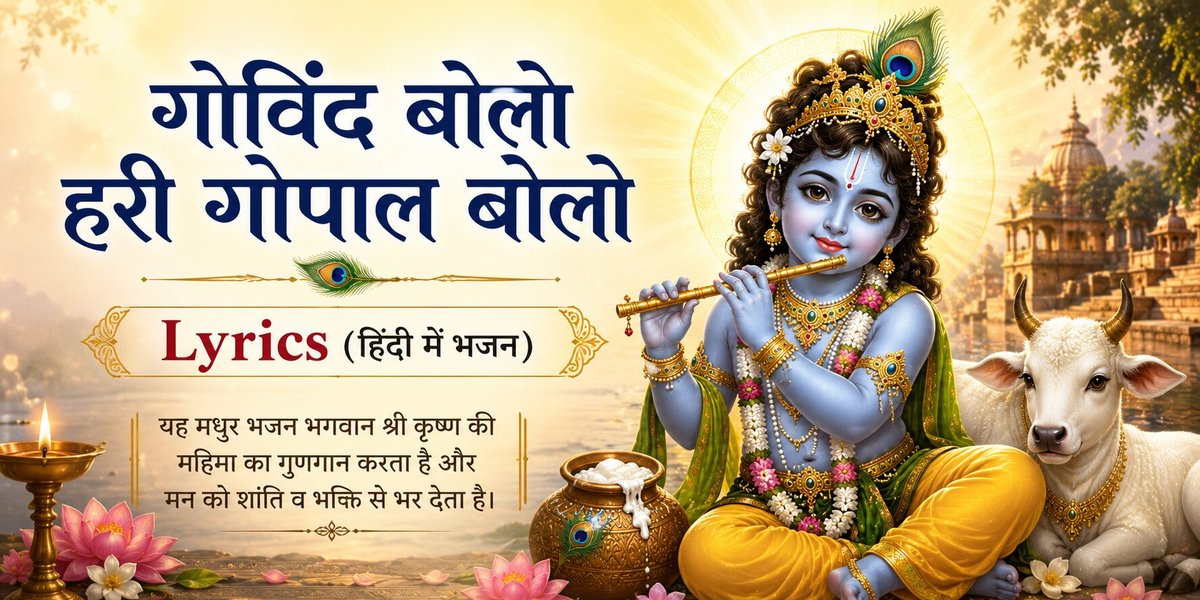
Gajendra's cry and the grace that answers: the devotional heart of Hey Govind Hey Gopal
Hey Govind Hey Gopal Rakho Sharan draws its spiritual core from one of the most beloved episodes in the Bhagavata Purana - the story of Gajendra, the great elephant king, who was seized by a crocodile in a sacred lake and, after exhausting every worldly resource, surrendered completely to the Lord. That moment of total self-surrender, sharanagati, is the theological heart of the bhajan. The composition attributed in tradition to the poet-saint Surdas channels that narrative into a direct, present-tense appeal: the devotee identifies with Gajendra, acknowledging helplessness and casting themselves upon divine grace without reservation.
The rasa here is dasya threaded through with aarta bhakti - the devotion of one who is genuinely in need and has nowhere else to turn. This emotional authenticity makes the bhajan particularly moving in congregational settings, where individual devotees often bring their own private burdens to the singing. It is traditionally associated with moments of crisis, illness, or grief, and is sung at evening bhajans and at Vaishnava satsangs where the Gajendra Moksha episode is remembered. The name Govind - the one who protects and gladdens the earth and its beings - resonates with special force in this context: it is both a name and a promise, and the bhajan rests its entire weight upon that promise.