Govind Bolo Hari Gopal Bolo – Calling Out the Names of Krishna
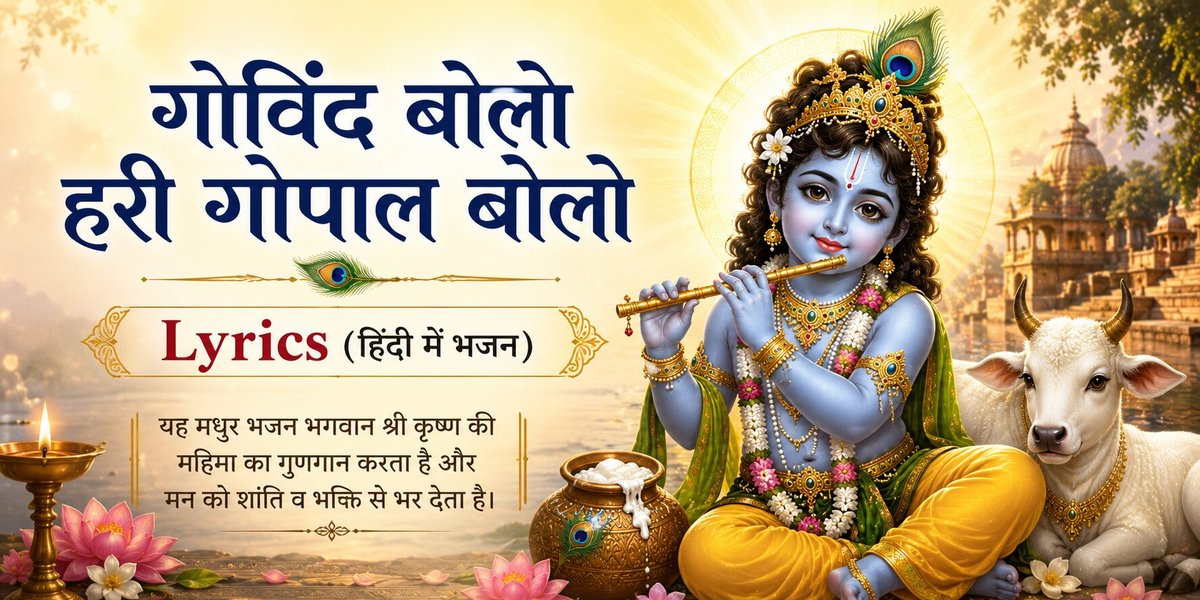
Govind Bolo as living kirtan: calling Krishna by name in the Bhakti tradition
Govind Bolo Hari Gopal Bolo is one of the most immediately recognisable kirtans in the Vaishnava devotional canon, beloved in ashrams, temples, and home puja rooms from the Himalayas to Kerala. Its structure is beautifully simple: an insistent, joyful call to speak - bolo, say it - the names of Govind, Hari, Gopal, Radha Ramana. That very simplicity is the point. The bhakti saints consistently taught that the name of the Lord is not a pointer toward the divine but is itself a living form of the divine, and Govind Bolo enacts that teaching by making the name both the subject and the act of the song.
In congregational settings, this kirtan typically begins at a moderate devotional pace and builds steadily in tempo and energy, drawing participants from seated listening into active, whole-body engagement - clapping, swaying, sometimes dancing. It is sung at morning aarti, at evening bhajan sessions, during festivals such as Janmashtami and Govardhan Puja, and at any moment a community wishes to collectively turn its attention toward Krishna. The rasa evoked is madhurya and sakhya combined - the sweetness of loving the Lord and the ease of speaking to a dear, close friend. For many devotees, this kirtan is a gateway: its accessibility makes it the first bhajan a child learns and, often, the last one an elder returns to.
Govind Bolo Hari Gopal Bolo Lyrics (हिंदी में)
गोविन्द बोलो हरी गोपाल बोलो।
राधा रमण हरी गोविन्द बोलो॥
श्री नन्दलाला बोलो हरी गोपाल बोलो।
राधा रमण हरी गोविन्द बोलो॥
ब्रह्मा के जनक बोलो हरी गोपाल बोलो।
राधा रमण हरी गोविन्द बोलो॥
राम रघुपति बोलो हरी गोपाल बोलो।
राधा रमण हरी गोविन्द बोलो॥
सीताराम बोलो हरी गोपाल बोलो।
राधा रमण हरी गोविन्द बोलो॥
गंगे हरि बोलो हरी गोपाल बोलो।
राधा रमण हरी गोविन्द बोलो॥
गोविन्द बोलो हरी गोपाल बोलो।
राधा रमण हरी गोविन्द बोलो॥
Govind Bolo Hari Gopal Bolo – Transliteration (English)
Govind bolo Hari Gopal bolo.
Radha Raman Hari Govind bolo.
Shri Nandlala bolo Hari Gopal bolo.
Radha Raman Hari Govind bolo.
Brahma ke janak bolo Hari Gopal bolo.
Radha Raman Hari Govind bolo.
Raam Raghupati bolo Hari Gopal bolo.
Radha Raman Hari Govind bolo.
Sitaram bolo Hari Gopal bolo.
Radha Raman Hari Govind bolo.
Gange Hari bolo Hari Gopal bolo.
Radha Raman Hari Govind bolo.
Govind bolo Hari Gopal bolo.
Radha Raman Hari Govind bolo.
Meaning & Significance
The bhajan is at its core an imperative of love: bolo - speak, call out, chant. Each successive invocation adds a new name or attribute of the divine, weaving together the entire Vaishnava sacred universe. Govind (the cowherd who gives joy to the cows and the earth), Hari (the remover of suffering and sin), Gopal (the shepherd of souls), Radha Raman (the beloved of Radha), Nandlala (the dear child of Nanda Maharaj), Brahma ke janak (the father of Brahma, underlining Krishna's supreme position), Ram Raghupati, Sitaram - the bhajan moves fluidly between the two great avatars, Krishna and Rama, affirming their essential unity.
About the Composer
Govind Bolo Hari Gopal Bolo is an anonymous traditional kirtan, with no identified individual poet-composer in the historical record. It belongs to the broader current of nama-sankirtan that gained immense impetus through the teachings of Chaitanya Mahaprabhu in the 16th century, though similar call-and-response patterns can be found in Vaishnava devotional gatherings across many earlier centuries. The bhajan's structure - a repeated exhortation with shifting divine names - is characteristic of the collective, participatory style of kirtan composition where any devotee could add a new name and the community would echo it back.
About Krishna
As Govind and Gopal, Krishna is intimately connected to the earth, the cows, and the natural abundance of Vraja. Govind derives from go (cow or the senses) and vind (the one who pleases or finds); as Gopal he is the protector of the cows and, metaphorically, the guardian of all living beings who depend on him as a herd depends on its cowherd. As Radha Raman - the one who delights Radha; he is the supreme object of divine love. The bhajan's juxtaposition of these names reveals a deity equally at home in cosmic grandeur and intimate pastoral tenderness.
Spiritual Significance & Benefits
- Chanting or listening to this bhajan is an act of nama-smarana - remembrance of the divine through the medium of sound - considered in the Bhakti tradition to be the most direct spiritual practice available in the Kali Yuga.
- The call-and-response structure transforms a solitary recitation into a community dialogue with the divine, strengthening the bonds of satsang (holy company).
- Repeating the many names of God in a single kirtan session is understood as a form of all-encompassing prayer that leaves no aspect of the divine unaddressed.
- The joyful, rhythmic character of the kirtan naturally lifts mood and dissolves mental preoccupations, creating an inner space of openness and peace.
- Invoking both Krishna and Rama in the same kirtan is held to bring comprehensive spiritual protection, as the two avatars together represent the full spectrum of divine virtues.
- Teaching this simple, repetitive kirtan to children is considered an early introduction to devotional practice that plants seeds of spiritual memory for life.
When & How It Is Sung
Govind Bolo Hari Gopal Bolo is one of the most widely sung kirtans at Janmashtami, Holi, and Ekadashi celebrations across India. It is a staple of evening satsang in ashrams, temples, and household puja rooms. The call-and-response format makes it ideal for large congregations, where a lead singer sings each line and the assembly echoes it. Musically it is often performed in a lively tempo in Raga Khamaj or in a simple folk melody that requires no classical training to participate in, ensuring universal accessibility. Instruments commonly used include the mridanga, karatalas (hand cymbals), harmonium, and in folk traditions the dholak.
Frequently Asked Questions
What does Radha Raman mean in this kirtan?
Radha Raman is a compound name meaning the one who gives joy to Radha, or the beloved of Radha. It is one of Krishna's most intimate epithets, highlighting his identity as the supreme object of divine love as experienced through Radha's eyes. There is also a famous self-manifested deity called Radha Ramanji at the Radha Raman Temple in Vrindavan, established in the 16th century, where this kirtan is particularly beloved.
Why does the bhajan mention both Krishna and Rama?
The Vaishnava tradition regards Krishna and Rama as two avatars of the same one Vishnu, and many Vaishnava kirtans celebrate both together. Invoking Ram Raghupati and Sitaram within a kirtan centred on Krishna acknowledges the full scope of Vishnu's incarnatory presence in the world and reflects the universalist spirit of the Bhakti movement, which sought to draw all devotees - regardless of their preferred form of the divine - into a single current of love.
Is Govind Bolo suitable for beginners in bhajan practice?
Govind Bolo Hari Gopal Bolo is considered one of the most accessible entry points into kirtan practice for precisely this reason: its structure is simple, its melody easily learned, and its repeated refrain allows a newcomer to participate almost immediately without memorising complex verses. The Bhakti tradition holds that any sincere calling of God's names, however simple, is spiritually valuable - making this kirtan both a doorway for beginners and a perennial favourite for experienced practitioners.