Krodhad Bhavati Sammohah: Gita's Verse on Anger (2.63)
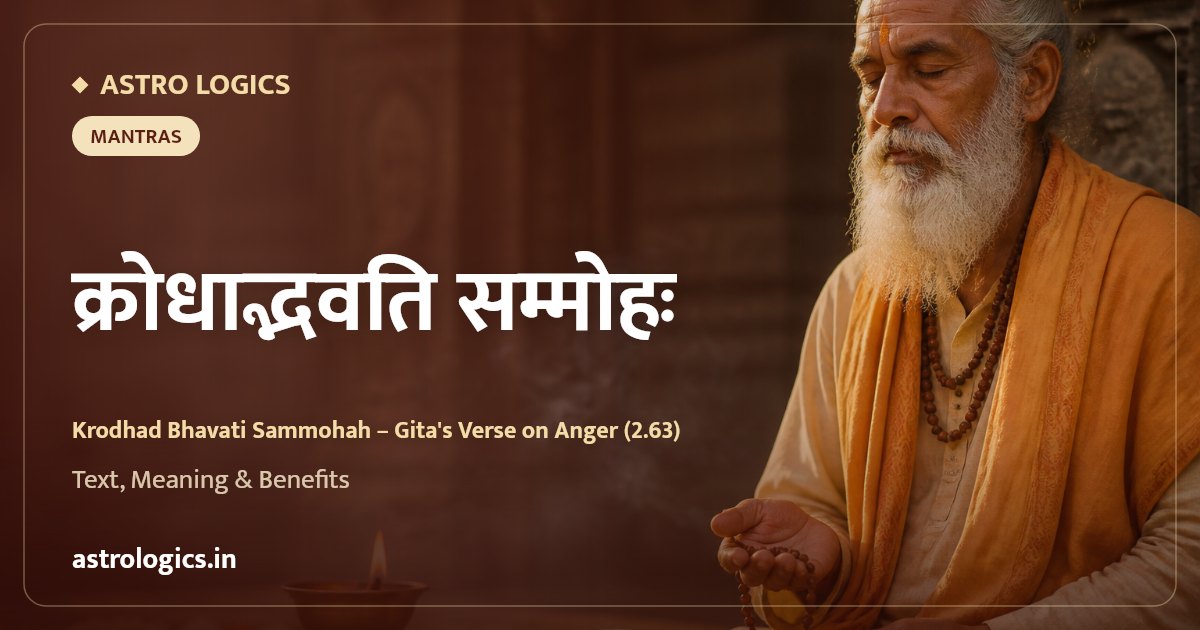
Krodhad Bhavati Sammohah (क्रोधाद्भवति संमोहः) - Sanskrit Text
क्रोधाद्भवति संमोहः संमोहात्स्मृतिविभ्रमः ।
स्मृतिभ्रंशाद् बुद्धिनाशो बुद्धिनाशात्प्रणश्यति ॥
- श्रीमद्भगवद्गीता, अध्याय २, श्लोक ६३
Transliteration (Roman/IAST)
krodhād bhavati saṁmohaḥ saṁmohāt smṛti-vibhramaḥ ।
smṛti-bhraṁśād buddhi-nāśo buddhi-nāśāt praṇaśyati ॥
Meaning
"From anger arises delusion; from delusion, the bewildering of memory; from the loss of memory, the destruction of discriminating intellect; and from the destruction of the intellect, one perishes." This single verse maps the precise psychological chain by which unchecked anger leads to a person's downfall - each rung of the ladder collapsing into the next.
About this Mantra
This is verse 63 of the second chapter (Sankhya Yoga) of the Bhagavad Gita, spoken by Lord Krishna to Arjuna. It is the culmination of Krishna's famous teaching (verses 62–63) on how attachment breeds desire, desire breeds anger, and anger sets off this cascade ending in ruin. Adi Shankaracharya's commentary explains how anger clouds the faculty of discrimination between right and wrong action, leaving a person incapable of sound judgement. The verse is among the most quoted in Indian thought as a concise teaching on emotional self-mastery.
Significance & Spiritual Benefits
Reflecting on this verse is a powerful tool for cultivating equanimity. By memorising and recalling it at the first stirring of anger, the practitioner interrupts the chain before delusion takes hold. It is a daily reminder that mastering anger protects memory, intellect and ultimately one's whole life. Repeated contemplation strengthens viveka (discrimination) and vairagya (dispassion), the twin pillars of inner stability.
Astrological Relevance
Anger and impulsive aggression are governed by Mangala (Mars), while sudden, uncontrollable rage and self-destructive impulses are linked to Rahu and to an afflicted Mars or a malefic in the lagna or third house. A poorly placed Mars or a difficult Mars/Rahu dasha can manifest as exactly the spiral this verse describes. Contemplating Gita 2.63 is a spiritual remedy that pairs naturally with Mars-pacifying measures (Hanuman worship, Tuesday observances) to channel fiery energy into discipline rather than destruction. Mercury (Budha), the karaka of intellect and memory, is protected when anger is mastered - making this verse a guard for buddhi itself.
How to Chant (Vidhi)
Recite the verse slowly each morning as part of a Gita-paath, and again whenever anger arises. Sit upright, take a few deep breaths, and recite it three times, letting the meaning sink in. It may be combined with the preceding verse (2.62) for the full teaching on the genesis of anger.
Best Day & Time
Daily morning study is ideal. Tuesday (Mars) is especially apt for working on anger and self-control, as is Gita Jayanti (Shukla Ekadashi of Margashirsha), the day the Gita was revealed.
Frequently Asked Questions
Where is this verse from?
It is Bhagavad Gita, Chapter 2 (Sankhya Yoga), verse 63, spoken by Sri Krishna to Arjuna.
What is the chain of cause it describes?
Anger leads to delusion, delusion to loss of memory, loss of memory to destruction of the intellect, and that to a person's ruin.
How can this verse help in daily life?
Recalling it at the onset of anger interrupts the destructive sequence and helps preserve clear judgement and self-control.




Krishna's chain of inner collapse - and how the Gita invites us to break it
Bhagavad Gita 2.63 is one of the most psychologically lucid verses in all of Indian philosophical literature. In it, Sri Krishna maps a precise chain of inner causation: unresolved craving gives birth to anger; anger engulfs the mind in delusion (sammohah); delusion destroys the capacity to remember one's own deeper values (smriti-bhramsha); and with memory corrupted, the buddhi - the discriminating faculty - collapses, after which a person is truly lost. This sequence is not presented as a moral lecture but as a clear-eyed description of a psychological mechanism, offered to Arjuna as the foundation for understanding why emotional sovereignty is indispensable to any form of meaningful action.
In the Jyotish tradition, Mars (Mangal) governs anger, impulsiveness and the fire of the ego, and an afflicted Mars in a natal chart is sometimes observed in individuals who struggle with the very cascade Krishna describes. Practitioners and teachers recommend contemplation of this verse not as a punishment for anger but as a compassionate diagnostic tool - sitting with it quietly, tracing one's own recent experiences of irritation back through the chain, and recognising the point of intervention. Devotees who reflect on verse 2.63 regularly find it becomes a living reference point, a gentle internal alarm that fires before sammohah fully takes hold.