Panchmukhi Hanuman Kavach: Sanskrit Text, Meaning, the Five Faces and How to Recite It
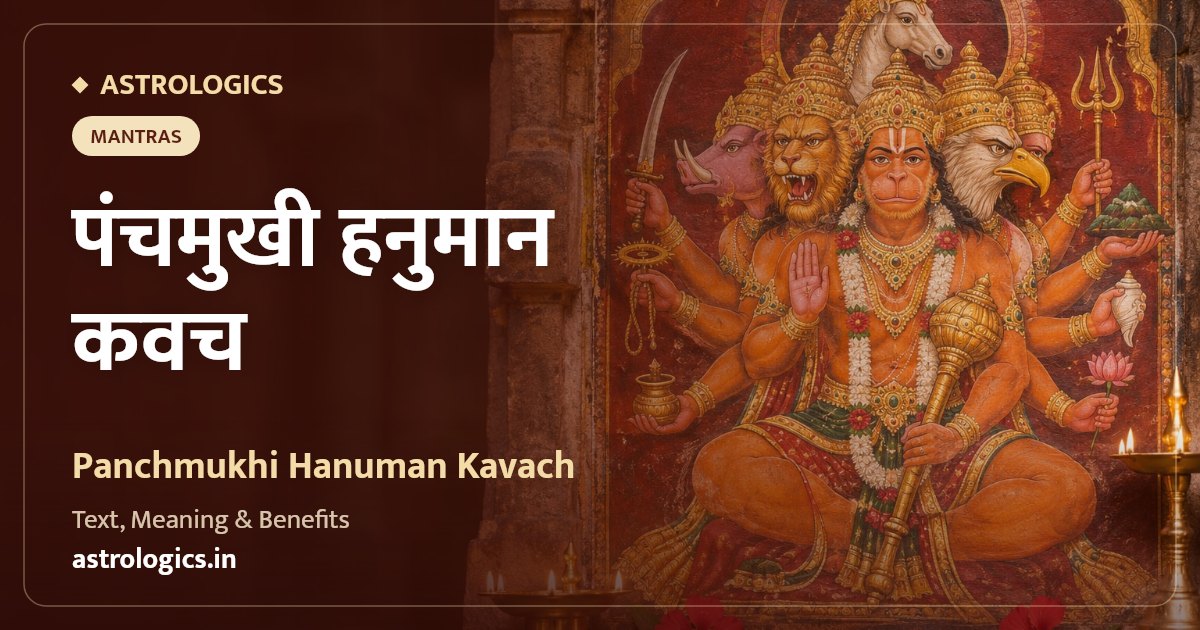
The Panchmukhi Hanuman Kavach is a kavach, a hymn of protection, in which Hanuman is worshipped with five faces, one for each direction and one looking upward. It comes from the Sudarshana Samhita, whose closing line calls it the kavach spoken by Sri Ramachandra and Sita. Devotees recite it on Tuesdays and Saturdays, in times of fear or illness, and whenever they want Hanuman's protection around the home. Below are the Sanskrit text, its meaning, the mantra of each face, and how to recite it.
संक्षेप में: पंचमुखी हनुमान कवच सुदर्शन संहिता का रक्षा-स्तोत्र है, जिसमें हनुमान जी पाँच मुखों के साथ हैं: पूर्व में वानर, दक्षिण में नरसिंह, पश्चिम में गरुड़, उत्तर में वराह और ऊपर हयग्रीव। लेख में विनियोग, गरुड़ द्वारा कहा गया ध्यान अर्थ सहित, पाँचों मुखों के मंत्र और फलश्रुति दी गई है, जो बताती है कि एक से ग्यारह बार पाठ का क्या फल है। साथ में मंगलवार और शनिवार को पाठ की विधि भी है। पूरा लेख हिंदी में पढ़ें →
The five faces of Panchmukhi Hanuman
In the dhyana, Garuda describes Hanuman with five faces, fifteen eyes and ten arms. Each face is a deity in its own right and guards against a different danger:
| Face | Direction | Grants |
|---|---|---|
| Vanara (Hanuman himself) | East | Overcomes every enemy |
| Narasimha | South | Removes fear and troubling spirits |
| Garuda | West | Takes away poison and snakebite |
| Varaha | North | Grants prosperity |
| Hayagriva | Upward | Wins the goodwill of all people |
The text adds that the upward Hayagriva face is the one that slew the great asura Taraka. Because the Narasimha face is part of the form, devotees of Narasimha often keep this kavach too.
Viniyoga
The kavach opens by naming its rishi (Brahma), its metre (Gayatri), its deity (the five-faced cosmic Hanuman) and its bija, shakti and kilaka. This is read once, before the dhyana.
ॐ अस्य श्री पञ्चमुखहनुमन्मन्त्रस्य ब्रह्मा ऋषिः ।
गायत्रीछन्दः । पञ्चमुखविराट् हनुमान्देवता । ह्रीं बीजम् ।
श्रीं शक्तिः । क्रौं कीलकम् । क्रूं कवचम् । क्रैं अस्त्राय फट् ।
इति दिग्बन्धः ॥
Panchmukhi Hanuman Kavach: Sanskrit text with meaning
Verses 1 and 2: Garuda begins
श्री गरुड उवाच ।
अथ ध्यानं प्रवक्ष्यामि शृणु सर्वाङ्गसुन्दरि ।
यत्कृतं देवदेवेन ध्यानं हनुमतः प्रियम् ॥ १॥
पञ्चवक्त्रं महाभीमं त्रिपञ्चनयनैर्युतम् ।
बाहुभिर्दशभिर्युक्तं सर्वकामार्थसिद्धिदम् ॥ २॥
Meaning: Garuda says: now I will describe the meditation on Hanuman, the one the god of gods himself made and holds dear. Hanuman has five faces and is mighty and fearsome, with fifteen eyes and ten arms, and he fulfils every wish and purpose.
Verses 3 to 8: the five faces
पूर्वं तु वानरं वक्त्रं कोटिसूर्यसमप्रभम् ।
दंष्ट्राकरालवदनं भृकुटीकुटिलेक्षणम् ॥ ३॥
अस्यैव दक्षिणं वक्त्रं नारसिंहं महाद्भुतम् ।
अत्युग्रतेजोवपुषं भीषणं भयनाशनम् ॥ ४॥
पश्चिमं गारुडं वक्त्रं वक्रतुण्डं महाबलम् ।
सर्वनागप्रशमनं विषभूतादिकृन्तनम् ॥ ५॥
उत्तरं सौकरं वक्त्रं कृष्णं दीप्तं नभोपमम् ।
पातालसिंहवेतालज्वररोगादिकृन्तनम् ॥ ६॥
ऊर्ध्वं हयाननं घोरं दानवान्तकरं परम् ।
येन वक्त्रेण विप्रेन्द्र तारकाख्यं महासुरम् ॥ ७॥
जघान शरणं तत्स्यात्सर्वशत्रुहरं परम् ।
ध्यात्वा पञ्चमुखं रुद्रं हनुमन्तं दयानिधिम् ॥ ८॥
Meaning: The eastern face is the monkey face, as bright as ten million suns, with fierce teeth and a frowning brow. The southern face is Narasimha, wondrous, blazing with fierce light, terrible to see and the destroyer of fear. The western face is Garuda, curved of beak and mighty, who calms every serpent and cuts away poison and evil spirits. The northern face is the boar, Varaha, dark and shining like the sky, who removes beings of the underworld, vetalas, fever and disease. The upward face is Hayagriva, the horse-faced one, the destroyer of demons, with which the great asura Taraka was slain. Meditating on this five-faced Rudra Hanuman, the ocean of compassion, one takes refuge in him, the remover of every enemy.
Verses 9 to 13: his weapons and form
खड्गं त्रिशूलं खट्वाङ्गं पाशमङ्कुशपर्वतम् ।
मुष्टिं कौमोदकीं वृक्षं धारयन्तं कमण्डलुम् ॥ ९॥
भिन्दिपालं ज्ञानमुद्रां दशभिर्मुनिपुङ्गवम् ।
एतान्यायुधजालानि धारयन्तं भजाम्यहम् ॥ १०॥
प्रेतासनोपविष्टं तं सर्वाभरणभूषितम् ।
दिव्यमाल्याम्बरधरं दिव्यगन्धानुलेपनम् ॥ ११॥
सर्वाश्चर्यमयं देवं हनुमद्विश्वतोमुखम् ।
पञ्चास्यमच्युतमनेकविचित्रवर्णवक्त्रं
शशाङ्कशिखरं कपिराजवर्यम् ।
पीताम्बरादिमुकुटैरूपशोभिताङ्गं
पिङ्गाक्षमाद्यमनिशं मनसा स्मरामि ॥ १२॥
मर्कटेशं महोत्साहं सर्वशत्रुहरं परम् ।
शत्रुं संहर मां रक्ष श्रीमन्नापदमुद्धर ॥ १३॥
Meaning: I worship him who holds in his ten hands the sword, trident, khatvanga staff, noose, goad and mountain, the fist, the Kaumodaki mace, a tree, the water pot, the bhindipala spear and the gesture of knowledge. He is seated on a throne, adorned with every ornament, wearing divine garlands and clothes and anointed with divine fragrance; he is full of wonders and faces every direction. I always remember in my mind the five-faced, imperishable one with faces of many colours, the moon on his crest, the best of the monkey kings, in yellow silk and a crown, with tawny eyes. O lord of the monkeys, full of zeal, remover of every enemy: destroy my enemies, protect me, and lift me out of danger.
The mantras of the five faces
After the dhyana, the kavach gives one mantra for each face. Many devotees chant these five on their own, facing the matching direction, as a short daily protection.
Vanara (Hanuman himself) face (East):
ॐ नमो भगवते पञ्चवदनाय पूर्वकपिमुखाय सकलशत्रुसंहारकाय स्वाहा
Narasimha face (South):
ॐ नमो भगवते पञ्चवदनाय दक्षिणमुखाय करालवदनाय नरसिंहाय सकलभूतप्रमथनाय स्वाहा
Garuda face (West):
ॐ नमो भगवते पञ्चवदनाय पश्चिममुखाय गरुडाननाय सकलविषहराय स्वाहा
Varaha face (North):
ॐ नमो भगवते पञ्चवदनायोत्तरमुखायादिवराहाय सकलसम्पत्कराय स्वाहा
Hayagriva face (Upward):
ॐ नमो भगवते पञ्चवदनायोर्ध्वमुखाय हयग्रीवाय सकलजनवशङ्कराय स्वाहा
The text then gives a second dhyana, which names all five faces in a single verse:
वन्दे वानरनारसिंहखगराट्क्रोडाश्ववक्त्रान्वितं
दिव्यालङ्करणं त्रिपञ्चनयनं देदीप्यमानं रुचा ।
हस्ताब्जैरसिखेटपुस्तकसुधाकुम्भाङ्कुशाद्रिं हलं
खट्वाङ्गं फणिभूरुहं दशभुजं सर्वारिवीरापहम् ॥
Meaning: I bow to the one with the faces of a monkey, Narasimha, Garuda the king of birds, the boar and the horse; divinely adorned, with fifteen eyes, blazing with light; holding in his ten lotus hands the sword, shield, book, pot of nectar, goad, mountain, plough, khatvanga, serpent and tree; the remover of every hostile warrior.
The full kavach in the Sudarshana Samhita goes on to a long section of bija mantras for particular rites, some of them aimed against enemies. Tradition gives those only from a guru to an initiated sadhaka, so they are left out here. What householders recite is the dhyana, the five face mantras and the phala-shruti given on this page.
Phala-shruti: what each number of recitations brings
इदं कवचं पठित्वा तु महाकवचं पठेन्नरः ।
एकवारं जपेत्स्तोत्रं सर्वशत्रुनिवारणम् ॥ १५॥
द्विवारं तु पठेन्नित्यं पुत्रपौत्रप्रवर्धनम् ।
त्रिवारं च पठेन्नित्यं सर्वसम्पत्करं शुभम् ॥ १६॥
चतुर्वारं पठेन्नित्यं सर्वरोगनिवारणम् ।
पञ्चवारं पठेन्नित्यं सर्वलोकवशङ्करम् ॥ १७॥
षड्वारं च पठेन्नित्यं सर्वदेववशङ्करम् ।
सप्तवारं पठेन्नित्यं सर्वसौभाग्यदायकम् ॥ १८॥
अष्टवारं पठेन्नित्यमिष्टकामार्थसिद्धिदम् ।
नववारं पठेन्नित्यं राजभोगमवाप्नुयात् ॥ १९॥
दशवारं पठेन्नित्यं त्रैलोक्यज्ञानदर्शनम् ।
रुद्रावृत्तिं पठेन्नित्यं सर्वसिद्धिर्भवेद्ध्रुवम् ॥ २०॥
निर्बलो रोगयुक्तश्च महाव्याध्यादिपीडितः ।
कवचस्मरणेनैव महाबलमवाप्नुयात् ॥ २१॥
॥ इति श्रीसुदर्शनसंहितायां श्रीरामचन्द्रसीताप्रोक्तं श्रीपञ्चमुखहनुमत्कवचं सम्पूर्णम् ॥
Meaning: Having read this kavach, one should read the great kavach. Reciting the stotra once wards off every enemy. Twice daily, it brings growth of sons and grandsons; three times, every kind of prosperity; four times, freedom from disease; five times, the goodwill of all people; six times, the favour of all the gods; seven times, every good fortune; eight times, the fulfilment of one's wishes; nine times, royal comforts; ten times, insight into the three worlds; and eleven times, the number of the Rudras, every siddhi. Even one who is weak, ill or suffering from serious disease gains great strength simply by remembering this kavach.
The phala-shruti is the text's own praise of the hymn. Most devotees take it as encouragement to recite with faith, not as a promise, and treat medical and legal troubles through the proper doctors and courts alongside their prayer.
How to recite the Panchmukhi Hanuman Kavach
- Day and time: Tuesday and Saturday are Hanuman's days. Recite in the morning after bathing, or in the evening after lighting the lamp.
- Place: sit facing east before an image of Panchmukhi Hanuman, or of Hanuman with Sri Rama, on a red or woollen asana.
- Offerings: a lamp of ghee or sesame oil, red flowers, sindoor and a sweet such as boondi or jaggery and roasted gram.
- Begin with Rama: chant Sri Rama's name a few times, since Hanuman is pleased first by devotion to Rama.
- Recite: read the viniyoga, the dhyana and the five face mantras, then the phala-shruti. Once a day is the usual practice; some keep three or eleven recitations on Tuesdays.
- Close: recite the Hanuman Chalisa or the Sankat Mochan Hanuman Ashtak, and end with the Hanuman aarti.
Pronounce the Sanskrit slowly and carefully; if the long text is hard at first, begin with the five face mantras and add the verses over time. For a longer daily practice, add the 108 names of Hanuman or the Sri Hanuman Hridaya Malika.
Panchmukhi Hanuman, Shani and protection
In the Jyotish tradition, Hanuman is worshipped for relief during Saturn's hard periods, and Saturday recitation is a common practice during Sade Sati. Whether Sade Sati is running for you shows on our Sade Sati calculator. Other kavachs of protection on this site include the Narayana Kavach; for more Hanuman mantras, see our Hanuman mantra guide.
Panchmukhi Hanuman Kavach: FAQs
What are the five faces of Panchmukhi Hanuman?
Vanara (Hanuman himself) facing east, Narasimha facing south, Garuda facing west, Varaha facing north, and Hayagriva facing upward.
Which text does the Panchmukhi Hanuman Kavach come from?
The Sudarshana Samhita. Its closing line calls it the Panchmukha Hanumat Kavach spoken by Sri Ramachandra and Sita, and the dhyana within it is spoken by Garuda.
When should the Panchmukhi Hanuman Kavach be recited?
On Tuesdays and Saturdays, in the morning after bathing or in the evening after lighting the lamp. Many devotees recite it once every day.
Can women recite the Panchmukhi Hanuman Kavach?
Yes. Women recite Hanuman's hymns, including this kavach, with devotion, as they do the Hanuman Chalisa.
What is the mantra of Panchmukhi Hanuman?
Each face has its own mantra; the eastern one is Om Namo Bhagavate Panchavadanaya Purvakapimukhaya Sakalashatrusamharakaya Svaha. All five are given above.
For the periods in your own chart when Hanuman's worship is most helpful, see your free kundli; for a personal reading, talk to an astrologer.