Mere To Giridhar Gopal Doosro Na Koi – Meera Bai's Vow of Sole Devotion
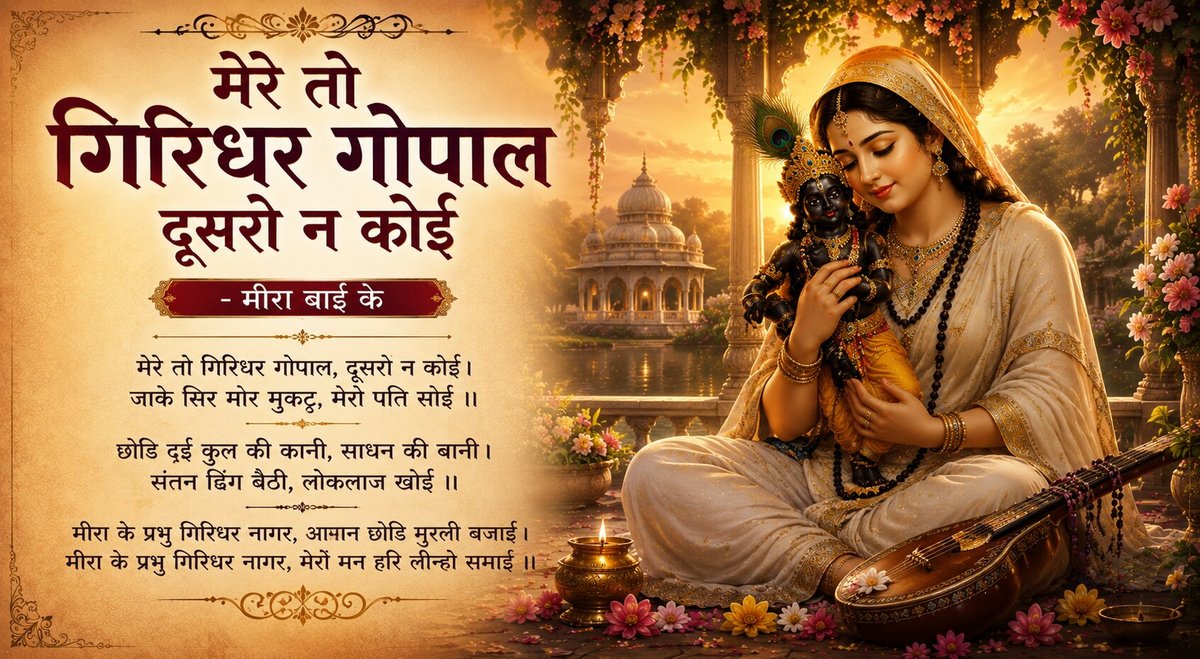
Meera's unbreakable vow and the freedom it won her
Mere To Giridhar Gopal Doosro Na Koi is perhaps the most direct and courageous declaration in all of Indian devotional poetry. Mirabai, the sixteenth-century Rajput princess who renounced royal comfort to live as a devotee of Krishna, pours into this bhajan the entire weight of her spiritual autobiography. The name she gives her beloved - Giridhar Gopal, the one who lifted Mount Govardhan - honours Krishna as the protector of the vulnerable. The dominant rasa is madhurya, the sweetness of total union with the divine beloved, but beneath the tenderness runs the steel of vira rasa - the heroic refusal to let social pressure dilute her love.
This bhajan is sung with especial fervour in Rajasthan and Vrindavan, and performed during Janmashtami, Ekadashi observances, and in satsangs dedicated to the bhakti saints. Her willingness to describe herself as one who has set aside social ties and sat among holy people has made her an enduring source of inspiration for anyone whose love of the divine sits in tension with worldly expectations. Devotees believe that singing Meera's padas opens the heart to a form of surrender where external validation becomes irrelevant, and the only audience that matters is the Lord himself. Few compositions in the bhakti canon match its combination of vulnerability and unshakeable certainty.
Mere To Giridhar Gopal Lyrics (हिंदी में)
मेरे तो गिरधर गोपाल, दूसरो ना कोई।
जाके सिर मोर मुकुट, मेरो पति सोई।
तात मात भ्रात बंधु, आपनो ना कोई।
छाड़ि दई कुलकानि, कहा करिहे कोई।
संतन ढिग बैठि बैठि, लोकलाज खोई।
भगत देखि राजी हुई, जगत देखि रोई।
अंसुवन जल सींचि सींचि, प्रेम बेलि बोई।
अब त बेलि फैल गई, आणंद फल होई।
दूध की मथनियाँ बड़े प्रेम से बिलोई।
माखन जब काढ़ि लियो, छाछ पिये कोई।
भगति भगति के कारणे मीरा दरस पोई।
मीरा के प्रभु गिरधर नागर, दरसण दे मोही।
Mere To Giridhar Gopal – Transliteration (English)
Mere to Girdhar Gopal, doosro na koi.
Jaake sir mor mukut, mero pati soi.
Taat maat bhrat bandhu, aapno na koi.
Chhad di kulkani, kaha karihe koi.
Santan dhig baith baith, lok laaj khoi.
Bhagat dekhi raaji hui, jagat dekhi roi.
Ansuvann jal seench seench, prem beli boi.
Ab to beli phail gayi, aanand phal hoi.
Doodh ki mathaniyaan bade prem se biloi.
Makhan jab kaadh liyo, chhaach piye koi.
Bhagti bhagti ke kaarne Meera daras poi.
Meera ke prabhu Girdhar Nagar, darsan de mohi.
Meaning & Significance
In this luminous padavali, Meera Bai declares with absolute certainty that only Giridhar Gopal - Krishna, the lifter of Govardhan, adorned with a peacock-feather crown - is her husband, her kin, her world. She has willingly cast aside clan honour and social convention to sit among the saints, losing worldly shame but gaining divine love. The vivid metaphor of churning milk captures the essence of her practice: through arduous devotion she extracted the butter of God-realisation, leaving the buttermilk of worldly opinion to those who care for it.
About the Composer
Meera Bai (c. 1498–1547 CE) was a princess of the Rathore clan of Merta, Rajasthan. Widowed young and persecuted by the royal family of Chittorgarh for her unconventional devotion, she refused all worldly ties and composed hundreds of deeply personal bhajans in Braja Bhasha and Rajasthani. Her verses, marked by courage, longing, and mystical joy, are regarded as high watermarks of the Nirgun and Sagun Bhakti traditions. Scholars trace her philosophical lineage to the Nimbarka and Ramananda sampradayas.
About Krishna
Krishna, worshipped as the complete manifestation of Vishnu, is called Giridhar - the holder of the mountain - because he lifted Govardhan Hill on his finger to shield the people of Vraja from Indra's wrath. As Gopal he tends the cosmic herd of souls with infinite care. The peacock feather in his crown is an emblem of divine beauty and sovereignty over the senses, making him the ideal spouse in the path of madhura-bhakti followed by Meera and countless devotees across the centuries.
Spiritual Significance & Benefits
- Reciting this bhajan nurtures the spirit of vairagya - loving detachment from worldly approval and fear of social censure.
- The verse about watering the vine of love with tears of longing is a guide to cultivating sincere, sustained devotion even through hardship.
- Regular singing strengthens one-pointed focus on the divine, a quality highly valued in all paths of yoga.
- The butter-churning metaphor inspires the seeker to pursue consistent spiritual practice (abhyasa) until the fruit of realisation is attained.
- As a declaration of divine surrender, the bhajan is said to dissolve the ego's grip and open the heart to Krishna's grace.
- Meditating on its final verse - the prayer for darshan - kindles the devotee's aspiration for direct spiritual experience.
When & How It Is Sung
Mere To Giridhar Gopal is sung at dawn and dusk prayer sessions, Janmashtami celebrations, and Meerabai Jayanti gatherings. It is particularly favoured at Vrindavan and Dwarka pilgrimage centres. The bhajan is rendered in a range of ragas including Bhairavi and Mishra Kafi, and its slow, meditative pace allows the devotee to contemplate each line as both poetry and prayer.
Frequently Asked Questions
What is the central message of Mere To Giridhar Gopal?
The central message is the radical completeness of divine love: when Krishna is accepted as one's supreme beloved, every earthly relationship becomes secondary. Meera is not rejecting the world out of hatred but out of the overflow of a love so total that nothing else can compete with it. The bhajan is both a personal declaration and a universal teaching about the nature of true bhakti.
Why does Meera call Krishna her pati (husband) in this bhajan?
In the madhura-bhakti tradition, the soul in its highest spiritual state relates to the divine as a beloved bride to her bridegroom. Meera had considered herself spiritually married to Krishna since childhood. Calling him pati is therefore not a literal social claim but a profound metaphysical statement: the only relationship that can never be severed, dissolved, or taken by death is the relationship between the soul and its divine source.
Is this bhajan performed in a specific raga?
The bhajan has been rendered in multiple ragas by different exponents. Raga Bhairavi, with its poignant and devotional character, is among the most common choices. Raga Mishra Kafi and Raga Pilu are also used in lighter, folk-influenced presentations. The choice of raga is left to the singer's intuition, since the emotional core of the text can be served by many melodic frameworks.