Shri Hanumat Pancharatnam: Lyrics, Meaning & Benefits
Shri Hanumat Pancharatnam - Sanskrit Text
वीताखिल-विषयेच्छं जातानन्दाश्र पुलकमत्यच्छम् ।
सीतापति दूताद्यं वातात्मजमद्य भावये हृद्यम् ॥१॥
तरुणारुण मुख-कमलं करुणा-रसपूर-पूरितापाङ्गम् ।
सञ्जीवनमाशासे मञ्जुल-महिमानमञ्जना-भाग्यम् ॥२॥
शम्बरवैरि-शरातिगमम्बुजदल-विपुल-लोचनोदारम् ।
कम्बुगलमनिलदिष्टम् बिम्ब-ज्वलितोष्ठमेकमवलम्बे ॥३॥
दूरीकृत-सीतार्तिः प्रकटीकृत-रामवैभव-स्फूर्तिः ।
दारित-दशमुख-कीर्तिः पुरतो मम भातु हनुमतो मूर्तिः ॥४॥
वानर-निकराध्यक्षं दानवकुल-कुमुद-रविकर-सदृशम् ।
दीन-जनावन-दीक्षं पवन तपः पाकपुञ्जमद्राक्षम् ॥५॥
एतत्-पवन-सुतस्य स्तोत्रं यः पठति पञ्चरत्नाख्यम् ।
चिरमिह-निखिलान् भोगान् भुङ्क्त्वा श्रीराम-भक्ति-भाग्-भवति ॥
॥ इति श्रीमच्छंकर-भगवतः कृतौ हनुमत्-पञ्चरत्नं संपूर्णम् ॥
Transliteration (Roman/IAST)
vītākhila-viṣayecchaṁ jātānandāśra pulakam atyaccham |
sītā-pati dūtādyaṁ vātātmajam adya bhāvaye hṛdyam || 1 ||
taruṇāruṇa mukha-kamalaṁ karuṇā-rasa-pūra-pūritāpāṅgam |
sañjīvanam āśāse mañjula-mahimānam añjanā-bhāgyam || 2 ||
śambara-vairi-śarātigam ambuja-dala-vipula-locanodāram |
kambu-galam anila-diṣṭam bimba-jvalitoṣṭham ekam avalambe || 3 ||
dūrī-kṛta-sītārtiḥ prakaṭī-kṛta-rāma-vaibhava-sphūrtiḥ |
dārita-daśamukha-kīrtiḥ purato mama bhātu hanumato mūrtiḥ || 4 ||
vānara-nikarādhyakṣaṁ dānava-kula-kumuda-ravikara-sadṛśam |
dīna-janāvana-dīkṣaṁ pavana tapaḥ pāka-puñjam adrākṣam || 5 ||
etat-pavana-sutasya stotraṁ yaḥ paṭhati pañcaratnākhyam |
ciram iha nikhilān bhogān bhuṅktvā śrī-rāma-bhakti-bhāg-bhavati ||
Meaning
1. I now meditate in my heart on the charming son of the wind, free of all desire for sense-objects, utterly pure, thrilled with tears of bliss, the foremost messenger of Sita's lord (Rama).
2. I long for that life-giving one whose face is a tender, dawn-red lotus, whose sidelong glance brims with the flood of compassion, of delightful glory, the good fortune of mother Anjana.
3. I take refuge in that one - whose arrows surpass those of Kama (the foe of Shambara), whose large, generous eyes are like lotus petals, whose neck is conch-like, who was appointed by the wind-god, whose lips glow like the bimba fruit.
4. May the form of Hanuman shine before me; he who removed Sita's anguish, who revealed the splendour and might of Rama, and who tore apart the fame of the ten-faced Ravana.
5. I behold him, the overseer of the host of vanaras, like the rays of the sun to the night-lotuses that are the demon clans, consecrated to the protection of the humble, the very ripened fruit of the wind-god's austerity.
Phala: Whoever recites this hymn of the wind's son, named the "Five Jewels," long enjoys here all worldly delights and becomes a sharer in devotion to Shri Rama.
About this Stotra
The Shri Hanumat Pancharatnam - "the Five Jewels of Hanuman" - is a celebrated short hymn composed by the great Adi Shankaracharya (8th century CE), the founder of the Advaita Vedanta tradition. As its name suggests, it is a setting of five jewel-like verses, each a polished meditation (bhavana) on a single luminous image of Lord Hanuman. Unlike a hymn of mere praise, it is framed as contemplation: "adya bhavaye" - "today I meditate upon" - inviting the devotee to actually visualise Hanuman's form in the heart.
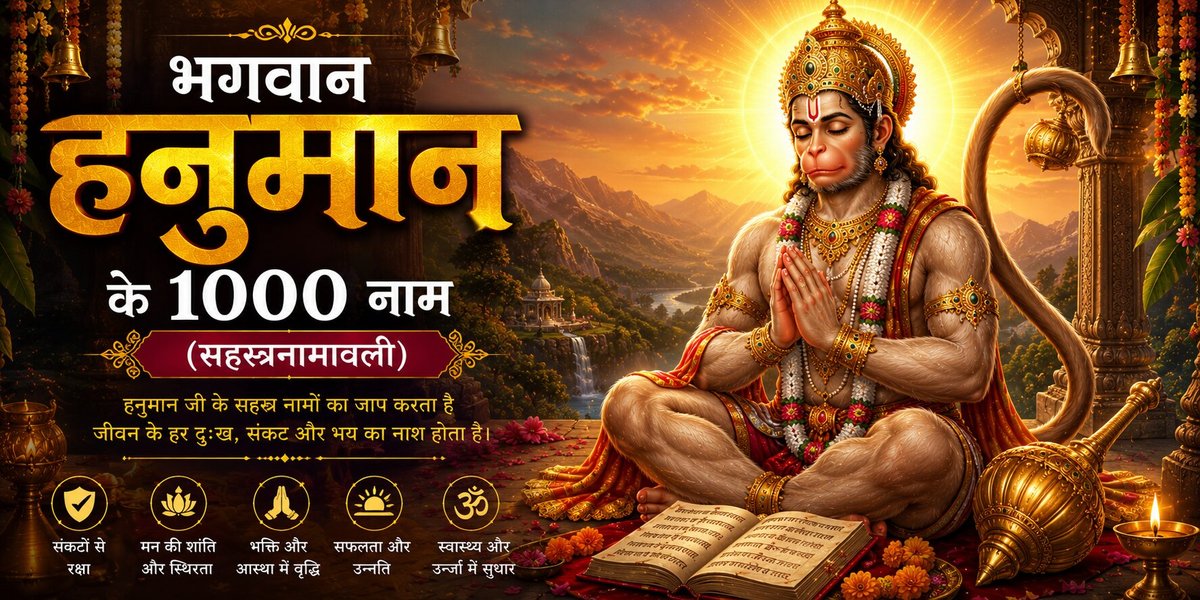
Shankaracharya draws Hanuman in his most beautiful aspect: the desireless devotee with tears of bliss, the dawn-red lotus face, the compassion-filled glance, the conch-like neck and bimba-red lips, the slayer of Ravana's fame and the saviour of the humble. The Pancharatnam is famed for its dense, alliterative Sanskrit, where sounds chime against one another - "mañjula-mahimānam añjanā-bhāgyam" - making it as musical to recite as it is profound to contemplate.
Significance & Spiritual Benefits
The phala-shruti gives a beautifully balanced promise: the devotee who recites the Pancharatnam "long enjoys all worldly delights" (nikhilan bhogan) and yet ultimately "becomes a sharer in devotion to Shri Rama" (Rama-bhakti-bhag) - uniting worldly well-being with the highest spiritual goal. This reflects Shankaracharya's vision of Hanuman as the perfect bridge between bhoga (enjoyment) and bhakti (devotion), the ideal devotee whose service to Rama is itself liberation.
The very first verse holds the key: Hanuman is "vita-akhila-vishayeccham," entirely free of craving for sense-objects, yet thrilled with tears of joy. Contemplating this teaches the devotee that true fulfilment comes not from grasping but from selfless love. Devotees recite it for strength, fearlessness, freedom from inner cravings and afflictions, and to deepen their devotion to Rama and Hanuman together.
Astrological Relevance
Lord Hanuman is the supreme deity of remedial worship for Mangal (Mars) and Shani (Saturn) in Vedic astrology. As the mighty, celibate, fearless son of the wind, he embodies the controlled, righteous strength of Mars, and his worship is the classic remedy for Mangal dosha (Manglik affliction), a debilitated or malefic Mars causing conflict, accidents and obstacles in marriage. Hanuman is equally the great pacifier of Saturn - tradition holds that Shani granted Hanuman the boon that those who worship him would be spared Saturn's harshest effects, making this hymn a valued recitation during Sade Sati, Shani dhaiya, or a difficult Saturn dasha. Because the Pancharatnam highlights Hanuman's desirelessness and courage, it is especially soothing for the mental fear and anxiety that hard Saturn and Mars periods bring, and supports a steady, fearless mind.
How to Chant (Vidhi)
After a bath, sit facing the rising sun or an image of Hanuman, ideally with Rama and Sita. Offer red flowers, sindoor mixed with oil (chola), a garland, and light a lamp with sesame or mustard oil; offer boondi or laddu. Begin with "Om Shri Hanumate Namah" or "Shri Ram Jai Ram," then recite the five verses slowly, letting the alliteration flow and visualising Hanuman's form as the hymn directs ("bhavaye" - meditate). Conclude with the phala-verse and a bow. Reciting it alongside the Hanuman Chalisa enhances the practice. Daily recitation, especially on Tuesdays and Saturdays, is most beneficial.
Best Day & Time
Tuesday (Mangalvar, the day of Mars and of Hanuman) and Saturday (Shanivar, for relief from Saturn) are the most auspicious days, and the early morning at sunrise or the evening twilight are ideal times. Hanuman Jayanti is the supreme occasion. For Mangal or Shani remedies, begin on a Tuesday or Saturday and maintain daily recitation.
Frequently Asked Questions
Who composed the Hanumat Pancharatnam?
It was composed by Adi Shankaracharya, the 8th-century founder of Advaita Vedanta, as stated in its colophon ("Shrimat-Shankara-bhagavatah kritau"). It is a public-domain Sanskrit hymn of five verses.
What does its fruit-verse promise?
The phala-shruti promises that one who recites it long enjoys all worldly delights and ultimately becomes a true devotee of Shri Rama - uniting material well-being with the highest devotion.
Is it useful for Mars and Saturn problems in astrology?
Yes. Hanuman is the primary remedial deity for both Mangal (Mars) and Shani (Saturn). This hymn is recited for Mangal dosha and during difficult Saturn periods such as Sade Sati, best on Tuesdays and Saturdays.
The five jewels of Hanuman's desireless devotion
Composed by Adi Shankaracharya, the Hanumat Pancharatnam stands apart from devotional hymns that simply enumerate a deity's glories. Its opening verse introduces Hanuman through an almost paradoxical lens: the mighty warrior who bears the Sanjivani mountain and demolishes Ravana's reputation is simultaneously the most perfectly desireless soul in the cosmos. This union of fearsome power and inner renunciation is the theological heart of the stotra, making it particularly beloved among Vedantic practitioners who see Hanuman not only as protector but as the very model of nishkama bhakti - devotion utterly free of personal agenda.
Devotees traditionally recite the Hanumat Pancharatnam on Tuesdays and Saturdays, and especially during Hanuman Jayanti, as a complete offering of praise that moves through the five facets of Hanuman's nature like five luminous gems strung on a single thread of surrender. In the Jyotish tradition, Hanuman is closely associated with the planet Mars as well as Saturn, and this stotra is among the remedies recommended for those who wish to cultivate strength, courage, and freedom from the grip of malefic planetary influences. The phala-shruti at the hymn's close assures the sincere reciter of worldly blessings alongside the rarest gift: steadfast Rama-bhakti that no circumstance can diminish.