Surya Dev Aarti – Jai Jai Ravidev: Lyrics, Meaning & Sunday Benefits
Surya Dev Aarti – Jai Jai Ravidev Lyrics (हिंदी में)
जय जय जय रविदेव, जय जय जय रविदेव।
रजनीपति मदहारी, शतदल जीवनदाता॥
जय जय जय रविदेव॥
षटपद मन मुदकारी, हे दिनमणि दाता।
जग के हे रविदेव, जय जय जय रविदेव॥
नभमंडल के वाणी, ज्योति प्रकाशक देवा।
निजजन हित सुखराशि, तेरी हम सब सेवा॥
करते हैं रविदेव, जय जय जय रविदेव॥
कनक बदन मन मोहित, रुचिर प्रभा प्यारी।
नित मंडल से मंडित, अजर अमर छविधारी॥
हे सुरवर रविदेव, जय जय जय रविदेव॥
Surya Dev Aarti – Jai Jai Ravidev – Transliteration (English)
Jai Jai Jai Ravidev, Jai Jai Jai Ravidev
Rajanipati Madhaari, Shatdal Jeevan Daata
Jai Jai Jai Ravidev
Shatpad Man Mudkaari, He Dinmani Daata
Jag ke he Ravidev, Jai Jai Jai Ravidev
Nabhmandal ke Vaani, Jyoti Prakaashak Deva
Nijjan Hit Sukh Raashi, Teri Hum Sab Seva
Karte hain Ravidev, Jai Jai Jai Ravidev
Kanak Badan Man Mohit, Ruchir Prabha Pyaari
Nit Mandal se Mandit, Ajar Amar Chhavi Dhaari
He Suravar Ravidev, Jai Jai Jai Ravidev
Meaning & Significance
Jai Jai Ravidev is a luminous devotional aarti honouring Surya, the Sun God, whose light is the most visible and tangible form of divine presence in daily human life. The name Ravidev combines Ravi (the Sun, one of the twelve Adityas) and Dev (god), asserting the divine sovereignty of the solar orb. The aarti's opening salutation - threefold repetition of "Jai Jai Jai Ravidev" - echoes the Vedic tradition of triple utterance, invoking the power of the sun across the three worlds (triloka).
The first verse describes Surya as Rajanipati Madhaari - "the one who conquers the lord of night," meaning he who vanquishes darkness - and as Shatdal Jeevan Daata, the life-giver whose rays sustain the lotus (shatdal, the hundred-petalled lotus) and all life. The second verse addresses him as Dinmani Daata, the jewel of the day, and the one who brings joy to the bee's (shatpad = bee) mind - an image drawn from Sanskrit poetic tradition where bees represent seekers drawn to the nectar of light. The third verse exalts the Sun as the voice of the celestial vault (nabhmandal ke vaani) and the illuminator of the entire cosmos, while the fourth and final verse praises his golden complexion and his eternal, ageless radiance - the sun that has shone without interruption since before memory.
About Surya Dev (The Sun God)
Surya, also called Aditya, Ravi, Bhaskar, and Bhanu, is the visible deity of the Hindu tradition - the one god whose form every human being sees with their own eyes every morning. In Vedic cosmology, the sun is the atma (soul) of the universe, and the Surya Namaskar (sun salutation) is the oldest known structured form of solar worship. Surya is one of the Navagrahas (nine planets) in Vedic astrology and is considered the king of all planets - a strong Sun in the natal chart confers leadership, vitality, self-confidence, good health, and paternal blessings; a weak or afflicted Sun brings self-doubt, health issues, and conflict with authority figures.
Surya is depicted in a golden chariot drawn by seven white horses, representing the seven colours of light and the seven days of the week, wearing a crown radiating solar beams, holding lotuses in both hands - symbols of purity and spiritual awakening sustained by light. The twelve Adityas (solar forms) presiding over the twelve months of the year are all aspects of the one supreme solar intelligence.
Benefits of Reciting the Surya Dev Aarti
- Strengthens the Sun's influence in the natal chart, supporting vitality, leadership, clarity of purpose, and paternal relationships.
- Sunday (Ravivar) recitation with Surya Arghya (water offering at sunrise) is one of the most powerful and simple remedies for a debilitated Sun.
- The aarti's themes of light, life-force, and eternal radiance align the devotee's consciousness with solar energy, enhancing confidence and mental clarity.
- Regular worship of Surya is associated in Ayurveda with eye health and overall vitality - the sun rules vision in both the physical and spiritual sense.
- Offering red flowers, wheat, and jaggery while reciting this aarti is a classical upaya for improving relationships with one's father and with authority figures.
- The practice of Surya aarti at dawn is considered among the most sattvic (pure) spiritual disciplines, aligning the devotee's biorhythm with the natural solar cycle.
How to Perform the Aarti (Pooja Vidhi)
- Rise before sunrise, bathe, and stand facing east - the direction of the rising sun - in a clean courtyard or open space.
- Prepare a copper vessel (lota) filled with clean water; add red flowers, red sandalwood powder, and a few grains of rice.
- As the sun appears on the horizon, pour the water slowly in a thin stream toward the sun, allowing the light to shine through the water arc - this is Surya Arghya, the sacred offering of water.
- After Arghya, face the sun and light incense and a ghee lamp on the puja plate; ring the bell and sing the Jai Jai Ravidev aarti.
- Recite the Surya Ashtakam or Aditya Hridayam if time permits before concluding with the aarti.
- Offer red flowers, wheat flour sweets, or jaggery as prasad, and donate to the needy - especially food or clothing - as part of the Sunday Surya observance.
Best Day & Time to Recite
Sunday (Ravivar) is Surya's day, and the pre-dawn period (Brahma muhurta) followed by the precise moment of sunrise is the most potent time for solar worship. The Saptami tithi (seventh lunar day) of each fortnight is also sacred to Surya, and the Ratha Saptami festival - falling on the seventh day of the bright half of Magha (January–February) - is the most important annual Surya celebration. The Sanskrit festival of Makar Sankranti (January 14) marks the sun's entry into Capricorn and is celebrated across India as a solar festival of new beginnings. Chhath Puja, observed in Bihar, Jharkhand, and parts of Uttar Pradesh, is the most elaborate public Surya worship tradition, where devotees stand in rivers offering arghya at both sunset and sunrise.
Frequently Asked Questions
What is the significance of offering water to the sun (Surya Arghya)?
Surya Arghya is the ancient practice of offering water to the rising sun while chanting solar mantras or this aarti. Scientific understanding notes that looking at sunlight through a thin stream of water is not harmful at the precise moment of sunrise, and the act synchronises the body's rhythms with the solar cycle. Spiritually, water is considered the most receptive element; it carries the devotee's prayers as it catches the sun's first rays. The refracted light visible through the water arc is regarded as a direct darshan (sacred sight) of the solar deity.
Is the Jai Jai Ravidev aarti different from the Om Jai Surya Bhagwan aarti?
Yes, these are two distinct aarti compositions. Om Jai Surya Bhagwan follows the same melody pattern as Om Jai Jagdish Hare and is often sung in congregational settings. Jai Jai Ravidev has its own distinct composition and meter, and is particularly associated with the traditional Surya puja performed at sunrise. Both are valid and beloved forms of solar praise; many temples sing the Jai Jai Ravidev form in the morning puja specifically.
Can Surya aarti help with health problems?
In the Vedic tradition, Surya governs vitality, bones, eyes, heart, and the immune system. Devotional and astrological traditions hold that sincere Surya worship - including this aarti, Surya Namaskar, and water offering - supports overall health and particularly benefits those dealing with vitamin D deficiency, low energy, or eye-related concerns. These practices are complementary to medical care and are not substitutes for professional healthcare.
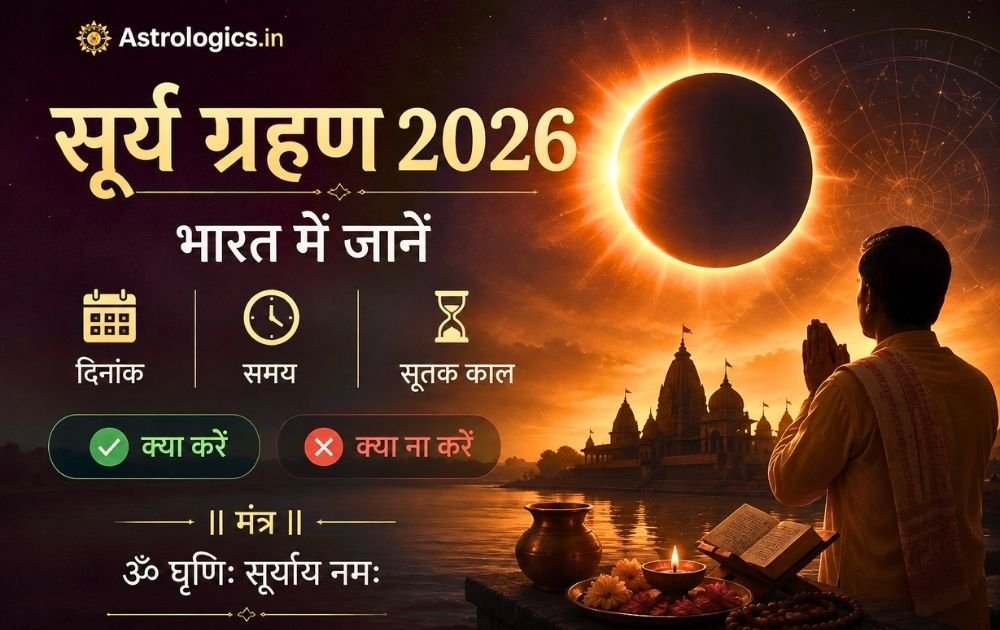
Sunday and eclipse days are the traditional occasions for this aarti. The next Surya Grahan is on 12 August 2026 — timing and sutak · rashi-wise effects.
Sunday's sacred flame: worshipping Surya Dev
The Jai Jai Ravidev aarti is sung in honour of Surya - the solar deity who is understood in the Vedic tradition as both the visible source of all earthly life and the inner witness of consciousness. Ravi is one of the most ancient names for the Sun, rooted in the Rigvedic hymns, and this aarti carries that antiquity into everyday morning worship in an accessible, melodic form. Sunday - Ravivar - is the day traditionally dedicated to Surya, and households that maintain a Sun-worship practice typically light a lamp, offer water at sunrise, and sing this aarti before beginning the day's work. In the Jyotish tradition, Surya represents the soul, authority, vitality, and the father principle; propitiating him is believed to strengthen one's sense of self, clarity of purpose, and overall health.
Devotees believe that sincere Surya puja, including the recitation of this aarti, can gradually ease the afflictions associated with a weakened or malefic Sun placement in the birth chart, and is especially recommended for those whose profession, confidence, or health feels diminished. Beyond astrology, however, the aarti carries a universally resonant message: that light - whether cosmic or inner - deserves to be honoured consciously each morning. The practice of pausing at dawn to offer gratitude to the Sun is one of the oldest continuous spiritual disciplines in Indian culture, and this aarti keeps that ancient impulse alive in a form every family can sing together.