Nirvana Shatakam (Atma Shatakam): Sanskrit Text, Meaning & Benefits
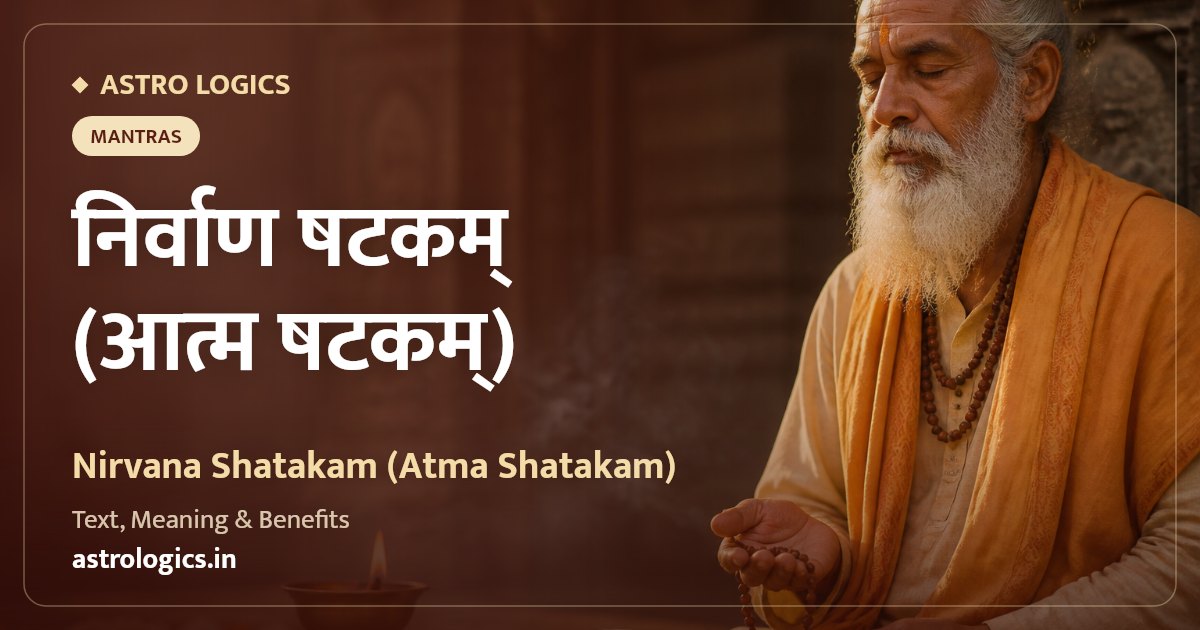
Nirvana Shatakam (Atma Shatakam) - Sanskrit Text
मनोबुद्ध्यहङ्कारचित्तानि नाहं
न च श्रोत्रजिह्वे न च घ्राणनेत्रे ।
न च व्योमभूमिर्न तेजो न वायुः
चिदानन्दरूपः शिवोऽहं शिवोऽहम् ॥ १॥
न च प्राणसंज्ञो न वै पञ्चवायुः
न वा सप्तधातुर्न वा पञ्चकोशः ।
न वाक्पाणिपादौ न चोपस्थपायू
चिदानन्दरूपः शिवोऽहं शिवोऽहम् ॥ २॥
न मे द्वेषरागौ न मे लोभमोहौ
मदो नैव मे नैव मात्सर्यभावः ।
न धर्मो न चार्थो न कामो न मोक्षः
चिदानन्दरूपः शिवोऽहं शिवोऽहम् ॥ ३॥
न पुण्यं न पापं न सौख्यं न दुःखं
न मन्त्रो न तीर्थं न वेदा न यज्ञाः ।
अहं भोजनं नैव भोज्यं न भोक्ता
चिदानन्दरूपः शिवोऽहं शिवोऽहम् ॥ ४॥
न मे मृत्युशङ्का न मे जातिभेदः
पिता नैव मे नैव माता न जन्म ।
न बन्धुर्न मित्रं गुरुर्नैव शिष्यः
चिदानन्दरूपः शिवोऽहं शिवोऽहम् ॥ ५॥
अहं निर्विकल्पो निराकाररूपो
विभुत्वाच्च सर्वत्र सर्वेन्द्रियाणाम् ।
न चासङ्गतं नैव मुक्तिर्न मेयः
चिदानन्दरूपः शिवोऽहं शिवोऽहम् ॥ ६॥
॥ इति श्रीमच्छङ्कराचार्यविरचितं निर्वाणषट्कं सम्पूर्णम् ॥
Transliteration (Roman/IAST)
mano-buddhy-ahaṅkāra-cittāni nāhaṃ
na ca śrotra-jihve na ca ghrāṇa-netre |
na ca vyoma-bhūmir na tejo na vāyuḥ
cidānanda-rūpaḥ śivo'haṃ śivo'ham || 1||
na ca prāṇa-saṃjño na vai pañca-vāyuḥ
na vā sapta-dhātur na vā pañca-kośaḥ |
na vāk-pāṇi-pādau na copastha-pāyū
cidānanda-rūpaḥ śivo'haṃ śivo'ham || 2||
(verses 3–5 continue, each denying identification with emotion, deed, kinship and death) …
ahaṃ nirvikalpo nirākāra-rūpo
vibhutvāc ca sarvatra sarvendriyāṇām |
na cāsaṅgataṃ naiva muktir na meyaḥ
cidānanda-rūpaḥ śivo'haṃ śivo'ham || 6||
Meaning
The hymn is a sustained meditation of self-inquiry, each verse stripping away a false identity and ending with the great declaration: "I am of the nature of consciousness and bliss; I am Shiva, I am Shiva." "I am not the mind, intellect, ego or memory; not the ears, tongue, nose or eyes; not space, earth, fire or air; I am consciousness-bliss, I am Shiva" (verse 1). "I am not the vital force or the five pranas, not the seven bodily constituents or the five sheaths, not the organs of speech, hands, feet or excretion; I am Shiva" (verse 2). "I have no aversion or attachment, no greed or delusion, no pride or envy; I am beyond dharma, wealth, desire and even liberation; I am Shiva" (verse 3). "I am not merit or sin, pleasure or pain, not mantra, pilgrimage, Veda or sacrifice; I am neither the food, the eating, nor the eater; I am Shiva" (verse 4). "I have no fear of death and no distinction of caste; I have no father or mother, no birth; no kinsman, friend, teacher or disciple; I am Shiva" (verse 5). "I am without alternatives, without form, all-pervading as the substratum of all the senses; ever the same, neither bound nor liberated nor measurable; I am consciousness-bliss, I am Shiva" (verse 6).
About this Stotra
The Nirvana Shatakam, also called Atma Shatakam ("the six verses on the Self"), is one of the most luminous works of Adi Shankaracharya. Tradition holds that the young Shankara composed it as his answer when his guru Govinda Bhagavatpada asked, "Who are you?" Rather than naming body, mind or lineage, he replied with this hymn of pure non-dual realisation, declaring his identity with Shiva - here understood not as the personal deity alone but as the supreme, formless, auspicious Self (Atman/Brahman). Through six verses of systematic negation (neti-neti), the hymn dismantles every limited self-image and rests in the unconditioned consciousness-bliss that is the true "I."
Significance & Spiritual Benefits
The Nirvana Shatakam is among the foremost texts of Advaita Vedanta used for contemplation and meditation. Its method is direct: by repeatedly affirming "I am not this body, not this mind, not these emotions, not even bound or free," the seeker disidentifies from the transient and abides as the witnessing consciousness. The refrain "Shivoham, Shivoham" - "I am Shiva, I am Shiva" - is itself a powerful mahavakya-style affirmation of the unity of the individual Self with the Absolute. Regular recitation and reflection are held to dissolve fear (especially the fear of death, explicitly denied in verse 5), loosen attachment and ego, bring deep inner peace, and lead toward the realisation of one's deathless nature. It is widely used as a meditation chant and is recited at times of grief and at the close of yogic practice.
Astrological Relevance
As the supreme hymn of Self-knowledge, the Nirvana Shatakam works at the level of the soul (Atman), the deepest significator of the Sun (Surya) and of the ninth and twelfth houses of dharma and moksha. It is a powerful remedy for the karmic shadow-planets Rahu and Ketu - Ketu in particular signifies detachment, moksha and the dissolution of the ego that this hymn directly cultivates - and for Shani (Saturn), the lord of detachment and endings. Because the hymn explicitly removes the "fear of death," it is recited for a weak or afflicted eighth house and for longevity-related anxieties, and as a meditative support during Sade Sati and the nodal dashas. Its emphasis on rising above pleasure and pain steadies an afflicted Moon, making it a profound remedy for the mind.
How to Chant (Vidhi)
This hymn is primarily for contemplation. Sit in a quiet place in a steady posture, facing east or north, ideally at dawn. Recite each verse slowly, pausing to reflect on the negations and to rest in the awareness behind them, and let the refrain "Shivoham, Shivoham" settle the mind into its source. It may be chanted aloud as a meditation or read silently as a reflection. No external materials are required, though lighting a lamp helps create a meditative atmosphere. Conclude by sitting in silence for a few minutes, abiding as the consciousness-bliss the hymn affirms.
Best Day & Time
It may be recited at any time, being a contemplative hymn, but Monday (Shiva's day), the Brahma-muhurta at dawn, and Maha Shivaratri are especially suited to it. It is also fitting at the end of meditation or yoga practice and at moments when one seeks peace beyond grief and fear.
Frequently Asked Questions
Why is it called Nirvana Shatakam?
"Nirvana" means liberation or the extinction of the limited self, and "shatakam" means a set of six verses. The hymn, also called Atma Shatakam, leads to liberation by negating every false identity and affirming the Self as pure consciousness-bliss - "Shivoham."
What is the story behind it?
Tradition holds that Adi Shankaracharya composed it as a young seeker in answer to his guru Govinda Bhagavatpada's question "Who are you?" Instead of identifying with body, mind or lineage, he declared his true nature as the formless, blissful Self, identical with Shiva.
What does "Shivoham" mean?
"Shivoham, Shivoham" means "I am Shiva, I am Shiva." Here Shiva signifies not only the personal deity but the auspicious, formless Absolute (the Self), so the phrase affirms the unity of the individual consciousness with the supreme reality.
Adi Shankaracharya's cry of liberation and what it means for seekers today
Composed by Adi Shankaracharya, the Nirvana Shatakam stands apart from devotional hymns that petition a deity for boons. Its six verses perform a radical act of negation: one by one, they strip away every layer of false identification - the physical body, the senses, the mind, the intellect, social roles, even the classical spiritual categories - until only the pure, luminous ground of awareness remains. The refrain Shivoham, Shivoham is not a mantra directed outward; it is a declaration turned inward, an affirmation of what the practitioner already and eternally is. This makes the hymn distinctive within the Advaita Vedanta tradition: it is simultaneously a philosophical statement and a direct contemplative practice.
Devotees and meditation practitioners recite the Nirvana Shatakam at the close of morning sadhana, during periods of intense introspection, or when confronted with grief and the fear of mortality. In the Jyotish tradition, Ketu, the headless planet of moksha and dissolution of ego, is intimately associated with the kind of inward turning this hymn invites, and some practitioners chant it as part of Ketu-related spiritual practice. Above all, it is an invitation to rest - however briefly - in the direct recognition that one's deepest nature is not a passing mood or a mortal body, but consciousness and bliss itself.