Shiv Panchakshar Stotram: Sanskrit Text, Meaning & Benefits
Shiv Panchakshar Stotram - Sanskrit Text
नागेन्द्रहाराय त्रिलोचनाय,
भस्माङ्गरागाय महेश्वराय।
नित्याय शुद्धाय दिगम्बराय,
तस्मै "न" काराय नमः शिवाय॥1॥
मन्दाकिनी सलिल चन्दन चर्चिताय,
नन्दीश्वर प्रमथनाथ महेश्वराय।
मन्दार पुष्प बहुपुष्प सुपूजिताय,
तस्मै "म" काराय नमः शिवाय॥2॥
शिवाय गौरी वदनाब्ज वृन्द,
सूर्याय दक्षाध्वर नाशकाय।
श्रीनीलकण्ठाय वृषध्वजाय,
तस्मै "शि" काराय नमः शिवाय॥3॥
वसिष्ठ कुम्भोद्भव गौतमार्य,
मुनीन्द्र देवार्चित शेखराय।
चन्द्रार्क वैश्वानर लोचनाय,
तस्मै "व" काराय नमः शिवाय॥4॥
यक्षस्वरूपाय जटाधराय,
पिनाक हस्ताय सनातनाय।
दिव्याय देवाय दिगम्बराय,
तस्मै "य" काराय नमः शिवाय॥5॥
पञ्चाक्षरमिदं पुण्यं यः पठेच्छिव सन्निधौ।
शिवलोकमवाप्नोति शिवेन सह मोदते॥
Transliteration (Roman/IAST)
nāgendrahārāya trilocanāya, bhasmāṅgarāgāya maheśvarāya।
nityāya śuddhāya digambarāya, tasmai "na" kārāya namaḥ śivāya॥1॥
mandākinī salila candana carcitāya, nandīśvara pramathanātha maheśvarāya।
mandāra puṣpa bahupuṣpa supūjitāya, tasmai "ma" kārāya namaḥ śivāya॥2॥
śivāya gaurī vadanābja vṛnda, sūryāya dakṣādhvara nāśakāya।
śrīnīlakaṇṭhāya vṛṣadhvajāya, tasmai "śi" kārāya namaḥ śivāya॥3॥
vasiṣṭha kumbhodbhava gautamārya, munīndra devārcita śekharāya।
candrārka vaiśvānara locanāya, tasmai "va" kārāya namaḥ śivāya॥4॥
yakṣasvarūpāya jaṭādharāya, pināka hastāya sanātanāya।
divyāya devāya digambarāya, tasmai "ya" kārāya namaḥ śivāya॥5॥
pañcākṣaram idaṃ puṇyaṃ yaḥ paṭhec chiva sannidhau।
śivalokam avāpnoti śivena saha modate॥
Meaning
This stotra unfolds the sacred five-syllable mantra of Lord Shiva, "Na-Ma-Shi-Vā-Ya", one syllable at a time. Each verse meditates on a single syllable and showers a cascade of Shiva’s attributes upon it.
The first verse (Na) bows to the One who wears the king of serpents as a garland, who has three eyes, whose body is smeared with sacred ash, the great Lord who is eternal, pure and clad in the directions themselves. The second (Ma) salutes the Lord anointed with water and sandal from the Mandakini (Ganga), the master of Nandi and the Pramatha hosts, worshipped with Mandara and countless flowers. The third (Shi) honours the auspicious one who is a sun to the lotus-face of Gauri, the destroyer of Daksha’s sacrifice, the blue-throated Lord whose banner bears the bull. The fourth (Va) reveres the Lord whose crown is worshipped by sages such as Vasishtha, Agastya (the pot-born) and Gautama, whose three eyes are the moon, the sun and fire. The fifth (Ya) adores the One in the form of a Yaksha, bearing matted locks, holding the Pinaka bow, ancient, divine and sky-clad. The closing verse promises that whoever recites this holy Panchakshara near Shiva attains Shiva’s abode and rejoices with him.
About this Stotra/Mantra
The Shiva Panchakshara Stotram is a compact hymn of garland-praise woven around the most beloved of all Shaiva mantras, the Panchakshara - "Namah Shivaya". Traditionally attributed to Adi Shankaracharya, it takes the five seed-syllables Na, Ma, Shi, Va and Ya and turns each into a doorway of devotion. In Shaiva understanding these five syllables correspond to the five elements - earth, water, fire, air and ether - so that to chant them is to honour Shiva as the very fabric of creation.
Because each verse ends with the refrain "namaḥ śivāya", the stotra is at once a hymn and an extended mantra-japa, making it ideal for daily worship before a Shiva Linga.
Significance & Spiritual Benefits
The Panchakshara is regarded as the heart of the Vedas distilled into five sounds. Reciting this stotra is believed to purify speech and mind, dissolve accumulated sins, and cultivate steady single-pointed devotion. The phalashruti (fruit-verse) declares that one who recites it in the presence of Shiva attains Shivaloka and eternal bliss in his company.
On a subtler level the hymn trains the aspirant to see the Divine in every element and direction, loosening attachment to the limited self and opening the heart to the all-pervading Lord.
Astrological Relevance
Lord Shiva is the presiding deity invoked for the remedy of malefic planetary influences, especially those of Shani (Saturn), Rahu and Ketu, and for the Moon, whom Shiva wears upon his brow. Devotees facing Sade Sati, a weak or afflicted Moon, or the dasha of Rahu/Ketu are traditionally advised to chant the Panchakshara. Because the mantra is mapped onto the five elements, it is also used to restore elemental balance in the chart and to strengthen a debilitated lagna. Monday, ruled by the Moon and sacred to Shiva, amplifies its remedial power.
How to Chant (Vidhi)
Bathe and sit facing east or north before an image or Linga of Shiva. Light a ghee or sesame-oil lamp and offer bilva (bel) leaves, water and white flowers. Begin with "Om Namah Shivaya" three times, then recite the five verses with attention to each syllable, and close with the phalashruti. A mala of 11 or 108 recitations is especially meritorious. Offering water or milk to the Linga during the chant (abhisheka) deepens the practice.
Best Day & Time
Monday (Somvar) is the foremost day, along with Pradosh Kaal (the twilight before sunset on the 13th lunar day), Maha Shivaratri, and the month of Shravan. Brahma Muhurta in the early morning is ideal for daily recitation.
Frequently Asked Questions
What does "Panchakshara" mean?
Panchakshara means "five syllables", referring to Na-Ma-Shi-Va-Ya, the core mantra "Namah Shivaya". The stotra glorifies one syllable per verse.
Can anyone chant the Shiva Panchakshara Stotram?
Yes. It is an open, universal hymn with no restriction of caste, gender or initiation. Sincere devotion and clean pronunciation are all that is required.
How many times should I recite it?
Even a single heartfelt recitation is beneficial, but many devotees chant it 5, 11 or 108 times, or daily on Mondays, for sustained blessings and inner steadiness.
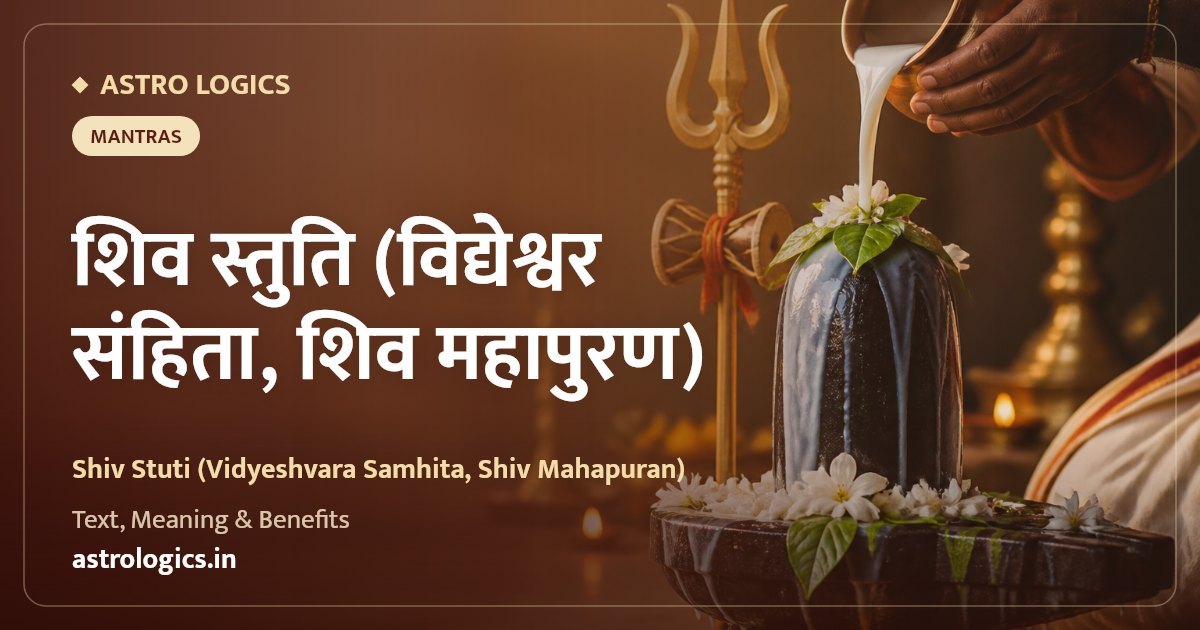
Five syllables, five elements, one unbroken Shiva
The Shiv Panchakshar Stotram, from the corpus attributed to Adi Shankaracharya, is among the most structurally elegant of all Shiva hymns: each of its five verses is built around one of the five syllables of the Panchakshara mantra - Na, Ma, Shi, Va, Ya - treating each syllable not as an abstract sound but as a portal into a distinct dimension of Shiva's nature. The first syllable opens onto the sage dwelling among the enlightened; the second onto devotees circling the sacred hills; and so on through to the fifth, which rests in the abode of Kailasa. The cumulative effect is of a single mantra unfolding like a lotus across five meditations, each complete yet pointing toward the whole.
This stotra is traditionally chanted on Mondays, on Maha Shivratri, and throughout the month of Shravan - the holiest period in the Shaiva calendar - typically after the abhisheka of a Shivalinga. In the Jyotish tradition, Saturn (Shani) and the Moon (Chandra) are the principal grahas connected to Shiva's worship: the Moon because Shiva bears the crescent in his matted hair and governs the mind, and Saturn because Shiva's domain of dissolution aligns with Saturn's themes of renunciation and karmic reckoning. Devotees who recite this stotra daily believe that its five syllables gradually settle into the breath so naturally that the mantra begins to chant itself - the moment when effort gives way to effortless remembrance.