Tulsi Vivah 2026: Date, Muhurat, Vidhi & Significance
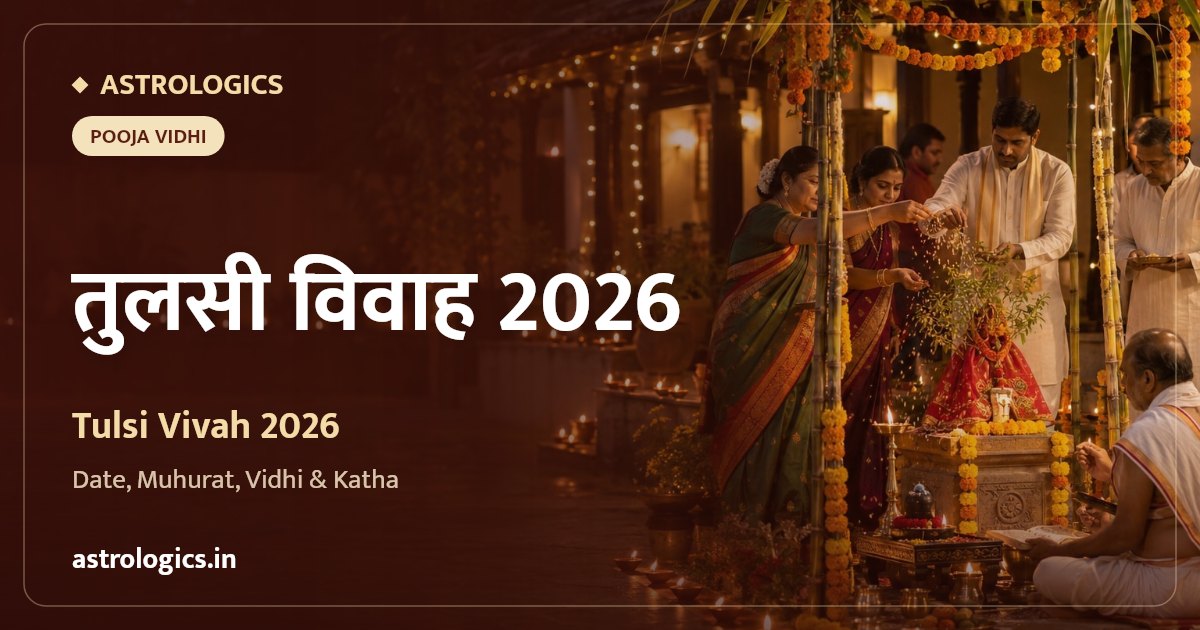
Tulsi Vivah 2026 is on Saturday, 21 November - the Kartik Shukla Dwadashi that falls immediately after Devutthana Ekadashi. The tithi begins at 06:32 AM, sixteen minutes before that day’s sunrise, so it holds the whole day cleanly.
Every date and time below is computed from our own Vedic panchang for Delhi - check any of it on the free daily Panchang - and it agrees with the date already given in our Devutthana Ekadashi guide, computed independently.
संक्षेप में: तुलसी विवाह 2026 शनिवार, 21 नवम्बर को है - कार्तिक शुक्ल द्वादशी, जो देवउठनी एकादशी के ठीक अगले दिन पड़ती है। द्वादशी तिथि प्रातः 06:32 पर, सूर्योदय से पहले, आरम्भ होकर रविवार, 22 नवम्बर प्रातः 04:57 तक रहती है। अधिकांश घरों में विवाह सूर्यास्त (सायं 05:25) के बाद संध्या को किया जाता है; दिन में विधि करने वाले परिवार अभिजित मुहूर्त, 11:43 से 12:31, चुनते हैं। विष्णु के जागने के साथ विवाहों का मौसम फिर आरम्भ होता है। पूरा लेख हिंदी में पढ़ें →
Tulsi Vivah 2026: date, tithi and muhurat
| Tulsi Vivah | Saturday, 21 November 2026 |
|---|---|
| Dwadashi tithi begins | Saturday, 21 November at 06:32 AM |
| Dwadashi tithi ends | Sunday, 22 November at 04:57 AM |
| Sunset (evening ceremony) | 05:25 PM |
| Brahma Muhurat | 05:12 AM to 06:00 AM |
| Abhijit Muhurat (midday option) | 11:43 AM to 12:31 PM |
| Rahu Kaal (avoid) | 09:28 AM to 10:47 AM |
| Nakshatra / Yoga | Revati (lord Mercury) / Siddhi (auspicious) |
Most households perform Tulsi Vivah in the evening, after sunset, in the same way a human wedding is conventionally timed - the window from 05:25 PM onward, while the Dwadashi tithi runs, is when it is done. Families who prefer a daytime ceremony use the Abhijit Muhurat instead. These timings are for Delhi; get your own city’s sunset and muhurat on the Muhurat finder.
Why Tulsi Vivah follows Devutthana Ekadashi
The day before, Lord Vishnu wakes from the four months of yoga-nidra that began on Devshayani Ekadashi, and Chaturmas - the season in which weddings and other auspicious ceremonies are paused - ends with him. Devutthana Ekadashi is when the household wakes the Lord; Tulsi Vivah, the next day, is the first wedding he attends - his own, to Tulsi. It is also, symbolically, the ceremony that formally reopens the wedding season for everyone else.
The story of Vrinda, Shaligram and Tulsi
Vrinda was the devoted wife of the demon king Jalandhar, and her unbroken chastity was the source of his invincibility in battle. To end a war the gods could not otherwise win, Vishnu is said to have taken Jalandhar’s form, and in that guise Vrinda’s fidelity was broken without her knowledge - the single act that allowed Jalandhar to finally be defeated.
When Vrinda understood what had happened, her grief and anger were such that she cursed Vishnu to turn to stone. He accepted the curse: that stone is the Shaligram, found in the Gandaki river and worshipped as Vishnu to this day. Vrinda herself, in her devotion, became the Tulsi plant. To honour her, Vishnu promised that he would remain eternally married to her in this form - and every year, on this Dwadashi, that wedding is performed again in Hindu homes, as both an act of devotion and an act of atonement remembered.
Tulsi Vivah vidhi - how the wedding is performed
- Clean the courtyard or the spot where the tulsi plant stands, and decorate it as you would for a wedding - rangoli, lamps, marigold.
- Dress the tulsi plant as the bride: a red chunri or dupatta around the pot, bangles, a bindi and sindoor at its base.
- Place a Shaligram, or an image or idol of Vishnu/Krishna, beside it as the groom.
- Stand four sugarcane stalks around the pot to form a small mandap, echoing the one raised the day before to wake Vishnu.
- Perform a kanyadaan-like rite - the woman of the house formally "gives away" Tulsi in marriage - then circle the tulsi and the Shaligram together seven times, as in the saptapadi of a human wedding.
- Recite the Mangalashtak (below) and sing wedding songs; the ceremony is as festive and as loud as a real wedding.
- Offer sugarcane, guava, amla and other fruit of the season, and distribute prasad - often a wedding-style sweet - to everyone present.
Mangalashtak & mantras for Tulsi Vivah
The Mangalashtak - eight verses, each ending kurvantu vo mangalam, "may these bestow auspiciousness upon you" - is recited at the moment of the union, exactly as at a human wedding. The full Sanskrit text, with meaning, is on our Tulsi Vivah Mangalashtak page.
ॐ तुलसी श्रीसखी शुभे पापहारिणि पुण्यदे।
नमस्ते नारदनुते नारायणमनःप्रिये॥
Significance for marriage and relationships
Tulsi Vivah is one of the days unmarried people pray on for a good and timely marriage, and married couples pray on for a harmonious one - the ceremony itself is a renewal of the ideal it depicts. Classical astrology also reads Tulsi as connected to Venus (relationship and marital harmony) and Shaligram/Vishnu to Jupiter (the karaka for marriage in a woman’s chart and for dharma generally), which is part of why this day is kept for exactly this purpose. Whether either graha needs active strengthening in your own chart is a question your own kundli answers, not the calendar.
Book a puja for Tulsi Vivah 2026
Tulsi Vivah itself is a household rite, performed at home. If you would also like a puja performed by pandits in your name for the harmony of a marriage - your own, or one you are praying for on someone else’s behalf - with sankalp, a recorded video, photographs and prasad couriered to you:
- Happy Marriage Life Puja - from ₹3,500
The full list is in the online puja store.
Tulsi Vivah 2026: FAQs
When is Tulsi Vivah in 2026?
Tulsi Vivah 2026 is on Saturday, 21 November, the Dwadashi tithi immediately after Devutthana Ekadashi. The tithi runs from 06:32 AM on the 21st to 04:57 AM on the 22nd.
What is the muhurat for Tulsi Vivah 2026?
Most households perform it in the evening from sunset, 05:25 PM (Delhi), while the Dwadashi tithi runs. Families who prefer a daytime ceremony use the Abhijit Muhurat, 11:43 AM to 12:31 PM.
Why is Tulsi Vivah performed the day after Devutthana Ekadashi?
Devutthana Ekadashi is when Lord Vishnu wakes from his four-month yoga-nidra and Chaturmas ends. Tulsi Vivah, the next day, is his own wedding - to Tulsi - and marks the formal reopening of the wedding season.
What is the story behind Tulsi Vivah?
Vrinda, wife of the demon Jalandhar, became the Tulsi plant after a chain of events involving Vishnu that ended with her cursing him to stone - the Shaligram. Vishnu promised to remain eternally wedded to her in that form, and Tulsi Vivah re-enacts that marriage every year.
Whether this year’s Tulsi Vivah brings the harmony you are praying for also depends on your own chart - start with a free Kundli, get the detailed ₹49 Kundli report, or talk to an astrologer about Venus, Jupiter and marriage timing in your own kundli.
More: Devutthana Ekadashi 2026 · Tulsi Vivah Mangalashtak.
Note: dates and timings on this page are computed from our own Vedic panchang for Delhi (28.61°N, 77.21°E) and follow the Purnimanta lunar month used in North India. They can differ by a few minutes with your city. Please confirm with your family’s panchang or a learned pandit before observing.
Building an app or website? Hindu festival and vrat dates for any year are available through the AstroLogics API.