Devutthana Ekadashi 2026: Date, Shubh Muhurat, Paran Time, Vrat Katha & Mantra
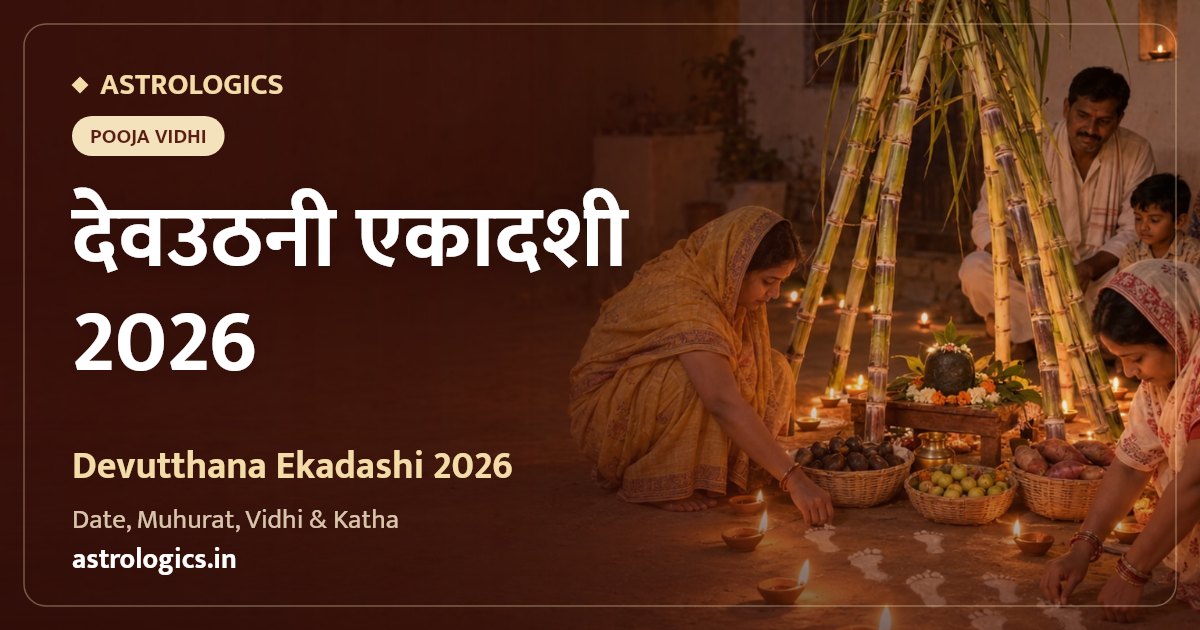
Devutthana Ekadashi 2026 falls on Friday, 20 November 2026. It is the Ekadashi of the Shukla paksha of Kartik - the day Vishnu wakes and the wedding season opens - and the fast is broken (paran) on Saturday, 21 November 2026 between 12:08 PM and 04:57 AM on 22 November.
Below is the complete guide to Devutthana Ekadashi 2026: the tithi timings, the shubh muhurat, the paran window and how it was worked out, the vrat vidhi, the vrat katha and the mantras of Lord Vishnu, waking from Chaturmas. Every date and time on this page is computed from our own Vedic panchang for Delhi, not copied from a calendar - you can check any of them yourself on our free daily Panchang.
संक्षेप में: देवउठनी एकादशी 2026 शुक्रवार, 20 नवम्बर को है। यह कार्तिक शुक्ल पक्ष की एकादशी है - जिस दिन भगवान विष्णु चातुर्मास की योगनिद्रा से जागते हैं और विवाह का मौसम फिर खुलता है। एकादशी तिथि 20 नवम्बर प्रातः 07:17 से 21 नवम्बर प्रातः 06:32 तक है, और पारण शनिवार, 21 नवम्बर को दोपहर 12:08 से 22 नवम्बर प्रातः 04:57 के बीच किया जाता है। सभी समय दिल्ली के लिए हैं। पूरा लेख हिंदी में पढ़ें →
Devutthana Ekadashi 2026: date, tithi and paran
| Vrat date | Friday, 20 November 2026 |
|---|---|
| Lunar month & paksha | Kartik, Shukla Paksha |
| Ekadashi tithi begins | Friday, 20 November 2026 at 07:17 AM |
| Ekadashi tithi ends | Saturday, 21 November 2026 at 06:32 AM |
| Paran (fast-breaking) | Saturday, 21 November 2026, 12:08 PM to 04:57 AM on 22 November |
| Nakshatra / Yoga | Uttara Bhadrapada (lord Saturn) / Vajra |
Devutthana Ekadashi 2026 shubh muhurat (Delhi)
- Brahma Muhurat: 05:12 AM to 06:00 AM
- Abhijit Muhurat: 11:43 AM to 12:31 PM
- Sunrise / Sunset: 06:48 / 17:26
- Rahu Kaal (avoid): 10:47 AM to 12:07 PM
Two things our own panchang shows that most listings will not. First, the Vajra yoga runs on this day, which classical texts count as difficult - it does not touch the vrat, but it is not a day to begin something unrelated. Second, and more important, the Ekadashi tithi does not cover sunrise on either day: it begins at 07:17 AM on 20 November, 29 minutes after sunrise, and ends at 06:32 AM on 21 November, 16 minutes before it. See the note below on which day to fast - it is a real question this year, not a formality.
These timings are for Delhi. Sunrise moves by up to about forty minutes across India, and the muhurats move with it - enter your own city on the Panchang for your local figures.
Which day to fast in 2026 - 20 or 21 November?
Most years this question does not arise. In 2026 it does, and we would rather show you the arithmetic than quietly pick a side.
Computed from our own panchang for Delhi: the Ekadashi tithi begins at 07:17 AM on Friday 20 November - 29 minutes after sunrise (06:48) - and ends at 06:32 AM on Saturday 21 November, 16 minutes before sunrise (06:48). So the Ekadashi tithi is present at sunrise on neither day.
The two main traditions resolve this differently, and both are internally consistent:
- Smarta / common panchang practice - fast on Friday 20 November. The Ekadashi tithi occupies almost the whole of that day, and it is the tithi a day-view panchang reports for the 20th. This is the date most Indian calendars print, and the date this article follows.
- Vaishnava practice - fast on Saturday 21 November. The Vaishnava rule refuses an Ekadashi that is dashami-viddha (touched by Dashami at sunrise), which the 20th is. Vaishnava sampradayas will therefore observe on the 21st, with paran on the 22nd.
If your family follows a Vaishnava sampradaya, or your temple has announced the 21st, follow that. Otherwise the 20th is correct for you. Tulsi Vivah is unaffected either way and is performed from the 21st.
Devutthana Ekadashi paran (fast-breaking) time
The paran is on Saturday, 21 November 2026, from 12:08 PM to 04:57 AM on 22 November. This paran is unusual and the reason is worth knowing: Dwadashi begins at 06:32 AM on 21 November, only minutes before sunrise, so Hari Vasara - the first quarter of Dwadashi, in which the fast must not be broken - runs until 12:08 PM. The paran is therefore a midday one, not a dawn one. Break the fast soon after 12:08 PM.
The window is worked out this way: the fast is broken on Dwadashi, after sunrise, once Hari Vasara - the first quarter of the Dwadashi tithi, in which paran is forbidden - has passed, and before the Dwadashi tithi itself ends. Breaking the fast early in the window is considered better than late, and leaving it until after Dwadashi has ended is held to undo the merit of the fast.
Significance of Devutthana Ekadashi
This is the largest Ekadashi of the year in practical terms. Devutthana - also Dev Uthani, Prabodhini or Devotthan Ekadashi - is the day Lord Vishnu wakes from the four-month yoga-nidra that began on Devshayani Ekadashi in Ashadha. The moment he wakes, Chaturmas ends, and with it the ban on auspicious beginnings. Weddings, griha pravesh, mundan and new ventures resume from this day. It is immediately followed by Tulsi Vivah, the ceremonial marriage of Tulsi to Shaligram, which is why so many households keep the two together. If a wedding is being planned in your family, this is the date the calendar has been waiting for.
Devutthana Ekadashi vrat vidhi - how to keep the fast
- Rise in the Brahma Muhurat (05:12 AM to 06:00 AM), bathe, and take the sankalpa - say plainly what the fast is for.
- Clean the puja space, place an image or idol of Lord Vishnu, waking from Chaturmas, and light a ghee lamp.
- Offer tulsi leaves, yellow flowers, sandalwood, incense, fruit and panchamrit. Tulsi is essential to any Vishnu vrat - but never pluck tulsi on the Ekadashi day itself; pick the leaves the evening before.
- Chant the Vishnu mantras below and read or listen to the Devutthana Ekadashi vrat katha.
- Keep the fast as your health allows - nirjala (waterless) is the strictest form and is optional; phalahar with fruit, milk and water is the common practice. Rice and grains are avoided by everyone keeping any Ekadashi.
- Spend the evening in bhajan and the aarti of Lord Vishnu. Many households stay awake (jagran) through the night.
- Break the fast (paran) the next day inside the window given above, after offering food and dakshina to a brahmin or to someone in need.
Devutthana Ekadashi vrat katha
In the beginning, the demon Shankhasura stole the Vedas and hid with them at the bottom of the ocean, and the world went dark in the way a world goes dark when it forgets what it knows. Vishnu took the form of Matsya, the fish, went down after him, killed him and brought the Vedas back. The effort of that descent is one of the reasons given for the Lord’s long sleep.
There is a second and gentler account. When Vishnu sent King Bali to the netherworld, Bali asked one boon in return: that the Lord himself dwell in his kingdom. Vishnu agreed, and so Lakshmi was left without her husband. She came to Bali in the form of a poor woman, tied a rakhi on his wrist, and asked for a gift - her husband back. Bali, who never refused a request, released him. Even then the Lord kept his promise partly: for four months of every year he rests in Bali’s realm, and returns on this day.
So on Devutthana Ekadashi the household does not merely worship - it wakes him. The courtyard is washed and drawn with rangoli, sugarcane is stood up in the shape of a small mandap, seasonal fruits, water chestnut and amla are offered, and lamps are lit through the evening. The family calls out together: Uthiye Deva, baithiye Deva - rise, Lord, be seated.
The next day Tulsi is married to Shaligram with the full rites of a wedding, and the wedding season of the year formally begins. It is the only festival where the community first wakes God and then immediately arranges a marriage.
Mantras to chant on Devutthana Ekadashi
Chant these during the puja and through the day’s japa:
ॐ नमो भगवते वासुदेवाय॥
ॐ नमो नारायणाय॥
शान्ताकारं भुजगशयनं पद्मनाभं सुरेशं
विश्वाधारं गगनसदृशं मेघवर्णं शुभाङ्गम्॥
ॐ श्रीं ह्रीं क्लीं महालक्ष्म्यै नमः॥
The complete aarti, chalisa and mantra texts are in our devotional library, and the Ekadashi Mata aarti is the one most families sing at the evening lamp.
Book a puja for Devutthana Ekadashi 2026
Devutthana Ekadashi is the day the wedding season reopens and Tulsi Vivah follows it, so the marriage rites belong to this week in a way they do not to any other. If you would rather have it performed properly by pandits on your behalf, with sankalp in your name, a recorded video, photographs and prasad couriered to you, these are the two that fit this vrat:
- Happy Marriage Life Puja - from ₹3,500
- Satyanarayan Katha Puja - from ₹3,100
Every puja is available in Individual, Family and Maha tiers; the full list is in the online puja store.
Devutthana Ekadashi 2026: FAQs
When is Devutthana Ekadashi in 2026?
Devutthana (Dev Uthani / Prabodhini) Ekadashi 2026 is on Friday, 20 November by the common panchang. The Ekadashi tithi runs from 07:17 AM on 20 November to 06:32 AM on 21 November. Vaishnava sampradayas observe it on 21 November - see the section above for why the two differ this year.
What is the Devutthana Ekadashi 2026 paran time?
The paran is on Saturday, 21 November 2026, from 12:08 PM, and must be completed before Dwadashi ends at 04:57 AM on 22 November. It is a midday paran, not a dawn one, because Hari Vasara - the first quarter of Dwadashi, in which the fast must not be broken - runs until 12:08 PM.
Do weddings start again after Devutthana Ekadashi?
Yes. Chaturmas ends when Lord Vishnu wakes on this day, and auspicious ceremonies - weddings, griha pravesh, mundan, new ventures - resume from it. Tulsi Vivah is performed immediately after and formally opens the wedding season.
What is Tulsi Vivah and when is it in 2026?
Tulsi Vivah is the ceremonial marriage of the Tulsi plant to Shaligram (Vishnu), performed with the full rites of a wedding. It follows Devutthana Ekadashi and is performed from 21 November 2026, on the Dwadashi.
Whether this vrat helps you the way the katha promises depends on far more than the date: it depends on which dasha you are running and what your own chart is doing. Start with your free birth chart on Free Kundli, get the detailed 46-page Kundli report for ₹49, or talk to an astrologer about the right vrat and remedy for your chart. Planning a ceremony? The free Muhurat finder will rank the days for you.
More from this series: Parivartini Ekadashi · Indira Ekadashi · Papankusha Ekadashi · Rama Ekadashi.
Note: dates and timings on this page are computed from our own Vedic panchang for Delhi (28.61°N, 77.21°E) and follow the Purnimanta lunar month used in North India. They can differ by city and by calendar tradition. The paran window follows the standard rule - after sunrise, after Hari Vasara, before Dwadashi ends. Please confirm with your family’s panchang or a learned pandit before observing the vrat.
Building an app or website? Every Ekadashi of a year, with its paran window, is available through the AstroLogics API.