Achyutam Keshavam Krishna Damodaram – Names of the Lord, Eternal and Sweet
Achyutam Keshavam Krishna Damodaram Lyrics (हिंदी में)
अच्युतम केशवं कृष्ण दामोदरम्।
राम नारायणं जानकी वल्लभम्॥
कौन कहता है भगवान आते नहीं।
तुम मीरा के जैसे बुलाते नहीं॥
अच्युतम केशवं कृष्ण दामोदरम्।
राम नारायणं जानकी वल्लभम्॥
कौन कहता है भगवान खाते नहीं।
बेर शबरी के जैसे खिलाते नहीं॥
अच्युतम केशवं कृष्ण दामोदरम्।
राम नारायणं जानकी वल्लभम्॥
कौन कहता है भगवान सोते नहीं।
माँ यशोदा के जैसे सुलाते नहीं॥
अच्युतम केशवं कृष्ण दामोदरम्।
राम नारायणं जानकी वल्लभम्॥
कौन कहता है भगवान नाचते नहीं।
गोपियों की तरह तुम नचाते नहीं॥
अच्युतम केशवं कृष्ण दामोदरम्।
राम नारायणं जानकी वल्लभम्॥
Achyutam Keshavam Krishna Damodaram – Transliteration (English)
Achyutam Keshavam Krishna Damodaram.
Rama Narayanam Janaki Vallabham.
Kaun kehta hai bhagwan aate nahin.
Tum Meera ke jaise bulaate nahin.
Achyutam Keshavam Krishna Damodaram.
Rama Narayanam Janaki Vallabham.
Kaun kehta hai bhagwan khaate nahin.
Ber Shabri ke jaise khilaate nahin.
Achyutam Keshavam Krishna Damodaram.
Rama Narayanam Janaki Vallabham.
Kaun kehta hai bhagwan sote nahin.
Maan Yashoda ke jaise sulaate nahin.
Achyutam Keshavam Krishna Damodaram.
Rama Narayanam Janaki Vallabham.
Kaun kehta hai bhagwan naachte nahin.
Gopiyon ki tarah tum nachaate nahin.
Achyutam Keshavam Krishna Damodaram.
Rama Narayanam Janaki Vallabham.
Meaning & Significance
The refrain of this bhajan is a garland of sacred names: Achyuta (the infallible one), Keshava (the slayer of the demon Keshi, or the one with beautiful hair), Krishna, Damodara (he around whose waist Mother Yashoda tied a rope), Rama, Narayana (the refuge of humanity), and Janaki Vallabha (the beloved of Sita). Each successive verse then challenges the sceptic who says God does not respond - pointing to the stories of Meera's divine vision, Shabari's offered berries, Yashoda's lullabies, and the gopis' Rasa dance as proof that the Lord comes to those who call with a pure heart.
About the Composer
This bhajan is considered a traditional composition in the Vaishnava devotional canon. Its refrain draws on the eight-verse Achyutashtakam attributed to Adi Shankaracharya, which catalogues Krishna's divine names with philosophical precision. The vernacular Hindi verses that follow the Sanskrit refrain appear to have evolved in the satsang and kirtan tradition, where composers often wove scriptural references and narrative vignettes around classical stotras to make them accessible to all devotees regardless of Sanskrit learning.
About Krishna
Each of Krishna's names in the refrain carries a distinct theological meaning. Achyuta affirms his absolute constancy; he never falls from his divine nature. Damodara recalls the episode in which Mother Yashoda tied him with a rope as punishment for mischief; the name encapsulates the paradox of the infinite submitting to love's small demands. As Keshava and Narayana, he encompasses both the personal beloved of the devotee and the impersonal ground of all existence, making him a complete object of worship for all temperaments.
Spiritual Significance & Benefits
- Chanting the divine names in the refrain is a form of nama-japa, said to purify the mind and attune it to higher frequencies of awareness.
- The verses refuting doubt serve as an antidote to spiritual dryness; they remind the practitioner that God's apparent absence is often a function of the quality of the call, not the divine willingness to respond.
- The stories of Shabari, Meera, and Yashoda offer archetypal models of devotion accessible to every age and station of life.
- Singing in call-and-response (kirtan) format strengthens community bonds and uplifts collective spiritual energy.
- Regular recitation is believed to bring steadiness (sthirta) of mind by anchoring attention to the unchanging divine names amid life's flux.
When & How It Is Sung
Achyutam Keshavam is popular at Vaishnava temple aartis, Janmashtami celebrations, Ram Navami, and daily satsang sessions. Its structure of a Sanskrit refrain alternating with Hindi verses makes it versatile - the refrain can be chanted as a mantra, while the verses are sung melodically. It is often presented in a brisk, joyful kirtan tempo in Raga Khamaj or Raga Bhairavi, and lends itself well to group participation because of its repetitive, easily learned pattern.
Frequently Asked Questions
What does Achyuta mean?
Achyuta is a Sanskrit epithet of Vishnu-Krishna meaning the infallible, the one who never falls or slips - neither from his divine nature, nor from the grasp of a devotee who holds fast to him. It appears in the Bhagavad Gita when Arjuna addresses Krishna, acknowledging his absolute, unshakeable reality as the foundation of all existence.
Why is Krishna called Damodara?
Damodara derives from the Sanskrit words dama (rope) and udara (belly/waist). It commemorates the episode in the Bhagavata Purana known as Damodara-lila, in which the infant Krishna broke two pots of butter and was playfully punished by Mother Yashoda, who attempted to tie him to a mortar. The name is celebrated each year in the month of Kartika with the Damodara prayers and lamp-offering ritual.
Is this the same as Achyutashtakam by Shankaracharya?
The refrain - Achyutam Keshavam Krishna Damodaram, Rama Narayanam Janaki Vallabham - draws on the opening verse of the Achyutashtakam, a Sanskrit stotra attributed to Adi Shankaracharya. The popular bhajan version, however, adds vernacular Hindi verses exploring stories of devotees, making it a hybrid of classical stotra and folk kirtan rather than a direct reproduction of the original ashtakam.
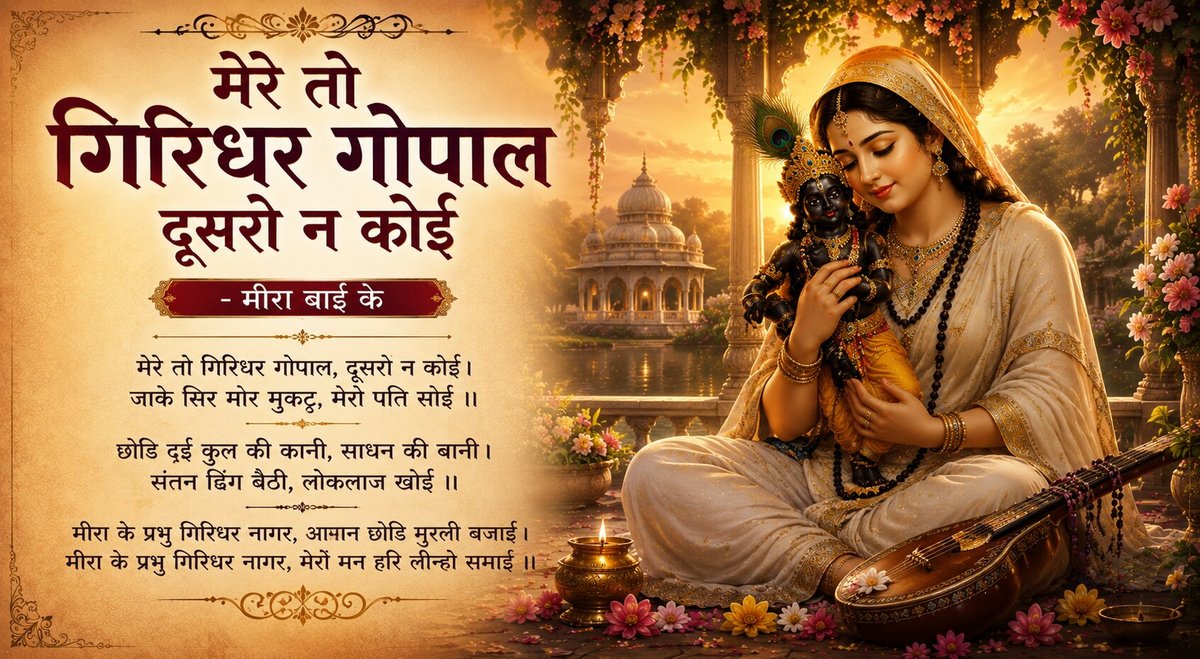
The power of divine names woven together: Achyutam Keshavam as nama-sankirtan
Achyutam Keshavam Krishna Damodaram belongs to that beloved category of devotional compositions whose primary method is the stringing together of divine names, each one carrying its own weight of mythology and meaning. Achyuta - the infallible one; Keshava - he who has beautiful hair, or slayer of the demon Keshi; Damodara - the one bound at the waist by Mother Yashoda: every name is a doorway into a story, a quality, a moment of divine tenderness or power. By chanting these names in succession, the devotee participates in what the bhakti tradition calls nama-sankirtan, the congregational or personal glorification of the Lord through his names - itself considered a complete spiritual path in the age of Kali.
This bhajan is a cherished part of temple kirtans and household puja across northern and western India, and its melody is deliberately joyful and accessible, inviting even children into the practice of nama-japa. The inclusion of both Krishna's names and references to Rama reflects a broad Vaishnava sensibility that sees these avatars as facets of the same supreme reality. Devotees who sing it regularly describe a quality of lightness and warmth - the mood is not one of formal petition but of delighted familiarity with the Lord, the rasa of sakhya and vatsalya blended into an easy, flowing praise.