Surya Ashtakam: Sanskrit Text, Meaning & Benefits
Surya Ashtakam - Sanskrit Text
आदिदेव नमस्तुभ्यं प्रसीद मम भास्कर ।
दिवाकर नमस्तुभ्यं प्रभाकर नमोऽस्तु ते ॥१॥
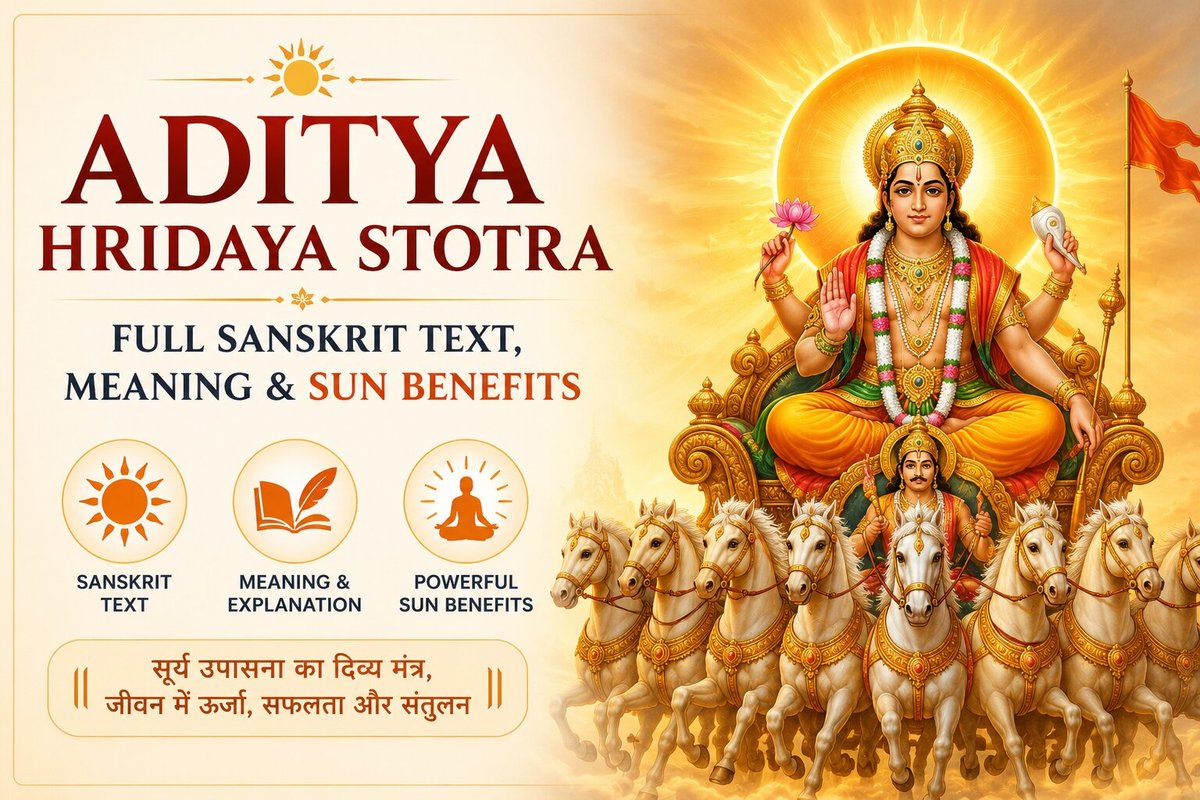
सप्ताश्वरथमारूढं प्रचण्डं कश्यपात्मजम् ।
श्वेतपद्मधरं देवं तं सूर्यं प्रणमाम्यहम् ॥२॥
लोहितं रथमारूढं सर्वलोकपितामहम् ।
महापापहरं देवं तं सूर्यं प्रणमाम्यहम् ॥३॥
त्रैगुण्यं च महाशूरं ब्रह्मविष्णुमहेश्वरम् ।
महापापहरं देवं तं सूर्यं प्रणमाम्यहम् ॥४॥
बृंहितं तेजःपुञ्जं च वायुमाकाशमेव च ।
प्रभुं च सर्वलोकानां तं सूर्यं प्रणमाम्यहम् ॥५॥
बन्धूकपुष्पसंकाशं हारकुण्डलभूषितम् ।
एकचक्रधरं देवं तं सूर्यं प्रणमाम्यहम् ॥६॥
तं सूर्यं जगत्कर्तारं महातेजःप्रदीपनम् ।
महापापहरं देवं तं सूर्यं प्रणमाम्यहम् ॥७॥
तं सूर्यं जगतां नाथं ज्ञानविज्ञानमोक्षदम् ।
महापापहरं देवं तं सूर्यं प्रणमाम्यहम् ॥८॥
॥ इति श्रीशिवप्रोक्तं सूर्याष्टकं सम्पूर्णम् ॥
Transliteration (Roman/IAST)
ādideva namastubhyaṁ prasīda mama bhāskara |
divākara namastubhyaṁ prabhākara namo'stu te ||1||
saptāśva-ratham-ārūḍhaṁ pracaṇḍaṁ kaśyapātmajam |
śveta-padma-dharaṁ devaṁ taṁ sūryaṁ praṇamāmyaham ||2||
(verses 3–8 close with the refrain "taṁ sūryaṁ praṇamāmyaham" - "I bow to that Sun.")
Meaning
The Surya Ashtakam is eight verses of salutation to the Sun-god. The opening verse hails him as Adideva (primeval Lord), Bhaskara, Divakara and Prabhakara - maker of light and day - and prays for his grace. The remaining verses describe him mounted on a seven-horsed chariot, son of Kashyapa, holding a white lotus; rider of the red chariot and grandsire of all worlds; embodiment of the three gunas and of Brahma, Vishnu and Shiva; a mass of radiance, lord of all the worlds, glowing like the bandhuka flower, adorned with necklace and earrings, bearer of the single wheel; maker of the world, kindler of great light, lord of all beings, and giver of knowledge, wisdom and liberation. The recurring refrain - "great destroyer of sin, I bow to that Sun" - is the heart of the hymn.
About this Stotra
The Surya Ashtakam is a classical hymn to Surya, traditionally framed as "spoken by Shiva" (śiva-prokta) - Lord Shiva teaching the praises of the Sun. It belongs to the great body of Saura (Sun-worship) literature and is recited as part of the Surya upasana practised since Vedic times. Compact and rhythmic, it is among the most popular Sun stotras for daily worship and for Sundays.
Significance & Spiritual Benefits
The Ashtakam is recited for health and vitality, for confidence and success, for the removal of sin (mahapapahara) and for inner light and clarity. The Sun is the source of life-energy and of the soul's own radiance; his worship is associated with strong eyesight, robust health, recovery from illness, and the dispelling of inner and outer darkness. Reciting it at sunrise while facing the rising Sun is a traditional way to begin the day with strength and purpose.
Astrological Relevance
Surya is the Sun (Ravi), the king of the grahas and karaka for the soul (atma-karaka), the father, authority, government, vitality, fame and self-confidence. The Surya Ashtakam is a primary remedy for a weak, debilitated, combust or afflicted Sun in the birth chart - conditions linked to low confidence, poor health, trouble from authority or the father, and bone, heart and eye ailments. It is recited especially on Sundays, during Surya's mahadasha or antardasha, and as part of arghya (water offering) to strengthen the Sun's benefic results.
How to Chant (Vidhi)
Rise early, bathe, and face the rising Sun. Offer arghya - water from a copper vessel, often reddened with roli or red flowers - while reciting. Then recite the eight verses with devotion, ideally seven times on Sunday. A red cloth, red flowers and the chanting of "Om Suryaya Namah" complement the practice. Conclude with a prayer for health, clarity and the welfare of all.
Best Day & Time
Sunday (Ravivar) is the Sun's day, and sunrise (especially while offering arghya) is the ideal time. Saptami tithi and Ratha Saptami are particularly auspicious for Surya worship.
Frequently Asked Questions
Who is said to have spoken the Surya Ashtakam?
By tradition it is "Shiva-prokta" - taught by Lord Shiva - as the colophon "iti śrī-śiva-proktaṁ sūryāṣṭakam" indicates.
How does it help astrologically?
It strengthens a weak or afflicted Sun, the karaka of soul, vitality, confidence and the father, and is recited especially on Sundays and during a Sun dasha or antardasha.
What is the simplest way to recite it daily?
Face the rising Sun after bathing, offer water (arghya) from a copper vessel, and recite the eight verses with the mantra "Om Suryaya Namah."
Saluting the sun at the still point of dawn
The Surya Ashtakam belongs to a tradition of dawn worship that stretches back to the earliest layers of the Vedic corpus, when the rising sun was greeted as the visible face of the divine - the one celestial reality that every human being, regardless of caste, region, or learning, could witness equally each morning. Its eight verses move through a rich vocabulary of solar epithets: Adideva, the primal deity; Bhaskara, the illuminator; Divakara, the maker of day. The tradition that these verses were transmitted by Lord Shiva himself elevates the hymn to the status of a teaching passed down through divine grace, and practitioners approach it with corresponding reverence.
The prescribed practice of reciting the Surya Ashtakam at sunrise while offering arghya - water held in cupped palms and poured as the light refracts through it - creates a daily ritual that is both devotional and profoundly grounding. In the Jyotish tradition, a well-placed and strong Sun governs confidence, vitality, father-figures, leadership, and the capacity for sustained effort, while an afflicted Surya can manifest as low vitality, poor self-esteem, or friction with authority. The Surya Ashtakam is among the most recommended remedial recitations for strengthening the Sun in the natal chart or propitiating it during its transit and dasha periods. Devotees believe that consistent practice at sunrise gradually instills clarity, dignity, and a sense of purposeful direction that reflects the Sun's own unwavering path across the sky.