Durga Saptashati Devimayi Stuti: Sanskrit Text & Meaning
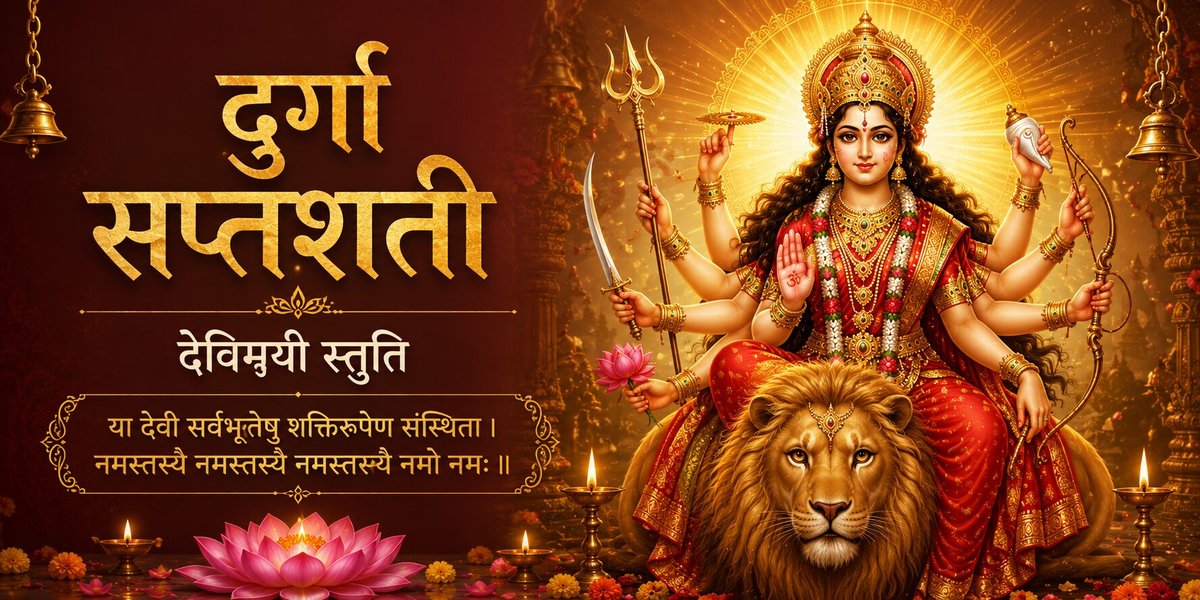
When words run dry: praising the Goddess who is speech itself
The Devimayi stuti from the Durga Saptashati tradition opens with a philosophical paradox: how can any tongue praise the Goddess when all speech, all words, all language are themselves her own manifestation? This non-dual recognition - that the entire universe is a continuous act of worship, every sound already a syllable of the Goddess - far from making praise redundant, deepens it. The devotee speaks knowing that the voice doing the praising, the ears receiving it, and the divine presence being praised are one seamless field of Devi's being. This is the vision of Shakta non-dualism expressed not in philosophical prose but in the living pulse of devotion.
Devotees recite this stuti as part of the Saptashati parayana, particularly during Navratri, and also independently as a brief but complete act of Devi worship. Its philosophical richness appeals especially to devotees who have studied Vedanta or Tantra and wish to ground their understanding in feeling. In the Jyotish tradition, the Goddess in her universal form is associated with the shakti underlying all planetary energies; this stuti, which recognises Devi in everything, is considered a way of harmonising one's relationship with all nine grahas simultaneously, since all of them operate within the field of her cosmic energy.
Durga Saptashati Devimayi Stuti - Sanskrit Text
तव च का किल न स्तुतिरम्बिके
सकलशब्दमयी किल ते तनुः।
निखिलमूर्तिषु मे भवदन्वयो
मनसिजासु बहिःप्रसरासु च।।
इति विचिन्त्य शिवे शमिताशिवे
जगति जातमयत्नवशादिदम्।
स्तुतिजपार्चनचिन्तनवर्जिता
न खलु काचन कालकलास्ति मे।।
Transliteration (Roman/IAST)
tava ca kā kila na stutirambike
sakalaśabdamayī kila te tanuḥ |
nikhilamūrtiṣu me bhavadanvayo
manasijāsu bahiḥprasarāsu ca ||
iti vicintya śive śamitāśive
jagati jātamayatnavaśādidam |
stutijapārcanacintanavarjitā
na khalu kācana kālakalāsti me ||
Meaning
"O Mother Ambika, what indeed is not your praise? For your very body is made of all words and sounds - every utterance is already a hymn to you. In all the forms of the universe, in the thoughts that arise within my mind and in all that spreads outside, I perceive my connection with you." Reflecting thus, O auspicious Shiva (Goddess), pacifier of all that is inauspicious, the devotee realises: "Since this whole world has come to be effortlessly as your own play, there is for me truly not a single moment of time that is empty of praising, repeating, worshipping or contemplating you." In other words, because the Goddess is the substance of every word and every form, all of life - speech, thought and action - becomes ceaseless worship of her.
About this Stuti
This short two-verse prayer, known popularly as "Devimayi" ("all is filled with the Devi") and by its opening words tava cha kā kila na stutih, belongs to the wider Durga Saptashati / Devi devotional tradition. Unlike the long battle-narratives of the Devi Mahatmya, it is a contemplative, non-dual hymn: it does not list the Goddess's deeds but realises that praising her is unavoidable, because the entire fabric of language and creation is her own form. It is cherished as a jewel of Shakta devotion for expressing the highest vision of the Mother as the all-pervading reality.
Significance & Spiritual Benefits
The stuti turns ordinary life into continuous worship. By recognising that every word is the Goddess's body and every form is suffused with her presence, the devotee is freed from the anxiety of "not doing enough" ritual - for nothing exists apart from her. Reciting and meditating on these verses cultivates a non-dual, ever-present devotion, deep peace, and the awareness of the Divine Mother in all experience. It is especially valued by those seeking the inner, contemplative dimension of Devi worship alongside outward ritual.
Astrological Relevance
As a hymn to the supreme Shakti who pervades all creation, this stuti is used devotionally to invoke the Mother's all-encompassing grace and protection. Its contemplative, mind-steadying nature makes it a soothing recitation for an afflicted Moon (mental peace and emotional balance) and a support during testing planetary periods, when surrender to the Divine Mother is sought as the deepest remedy. Recited during Navratri, it crowns the worship of Durga with the realisation that the Goddess is the very ground of one's being, harmonising the worshipper with the cosmic order.
How to Chant (Vidhi)
After bathing, sit calmly before an image of Maa Durga/Ambika. Light a lamp and offer flowers and incense. Recite the two verses slowly, dwelling on their meaning - that all words and forms are the Goddess herself. It is well suited to quiet, meditative repetition after the main Durga Saptashati or Devi worship, or as a standalone contemplation. Conclude by resting in the awareness of the Mother's all-pervading presence.
Best Day & Time
Navratri (Chaitra and Sharad) is the supreme time. Otherwise, Tuesdays and Fridays, and the Ashtami/Navami tithis, are ideal. The serene hours of dawn and dusk best suit this contemplative stuti.
Frequently Asked Questions
What does "Devimayi" mean?
It conveys that everything is filled with the Devi - the Goddess pervades all words and forms, so the whole universe is suffused with her presence.
What is the central idea of this stuti?
That praising the Goddess is unavoidable, because her body is made of all sounds and all forms; therefore every word, thought and act is already worship of her.
When is it recited?
It is recited during Navratri and Devi worship, often as a contemplative conclusion to the Durga Saptashati, and on Tuesdays and Fridays sacred to the Goddess.