Sankat Mochan Hanumanashtak – Baal Samay Ravi Bhaksh Liyo Lyrics & Meaning
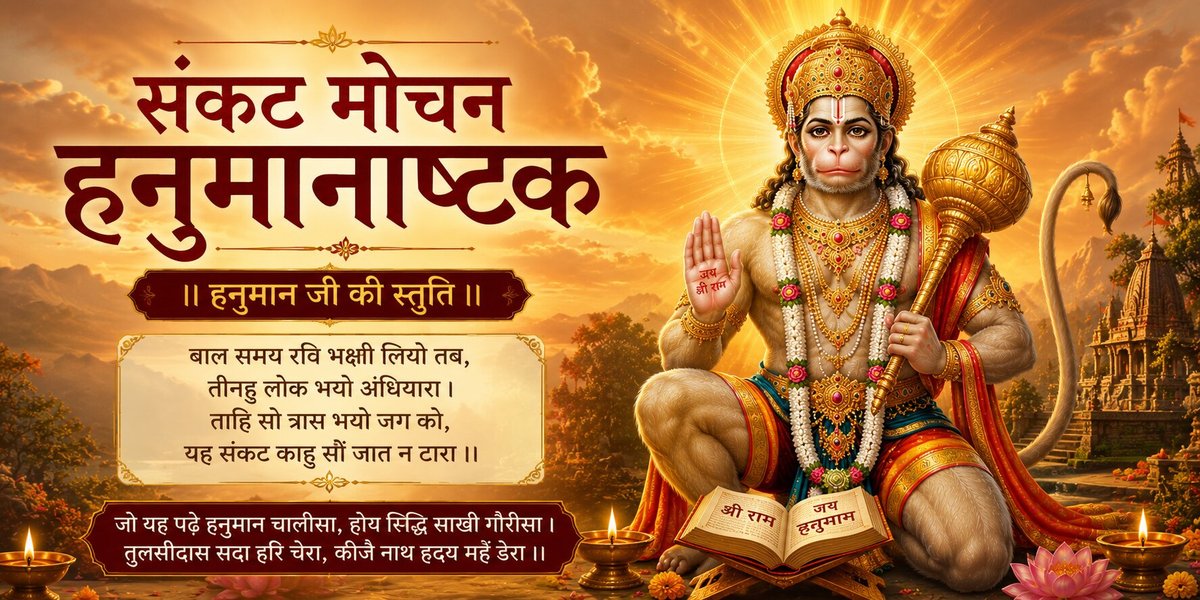
Eight verses that honour the fearless hero of every crisis
The Sankat Mochan Hanumanashtak is attributed to Goswami Tulsidas, whose devotion to Lord Rama and Hanuman shaped devotional practice across north India in ways that endure today. This ashtak - eight verses - opens with one of Hanuman's most dramatic childhood feats: the young Maruti mistaking the rising sun for a ripe fruit and leaping skyward to swallow it, plunging the cosmos into darkness. This image immediately establishes Hanuman's character as one whose power is extraordinary, playful, and ultimately surrendered to a higher purpose. The title itself - Sankat Mochan, the Reliever of Distress - frames the entire composition as a cry for help directed at the one whose nature is to answer exactly such calls.
Tuesdays and Saturdays are the days traditionally associated with Hanuman worship, and the Hanumanashtak is recited on both, as well as during Hanuman Jayanti and whenever a devotee faces acute difficulty. In the Jyotish tradition, Hanuman is closely linked with Saturn (Shani), and propitiation of Hanuman on Saturdays is widely understood as a means of softening harsh Shani transits and mitigating the effects of Sade Sati. The Hanumanashtak thus serves simultaneously as devotional poetry, protective prayer, and planetary remedy - a remarkable convergence of bhakti and Jyotish wisdom compressed into eight verses.
Sankat Mochan Hanumanashtak Lyrics (हिंदी में)
बाल समय रबि भक्षि लियो तब, तीनहुँ लोक भयो अँधियारो।
ताहि सों त्रास भयो जग को, यह संकट काहु सों जात न टारो॥
देवन आन करि बिनती तब, छाँड़ि दियो रबि कष्ट निवारो।
को नहिं जानत है जग में कपि, संकटमोचन नाम तिहारो॥ 1 ॥
बालि की त्रास कपीस बसैं गिरि, जात महाप्रभु पंथ निहारो।
चौकि महाभट मारे विराधहि, भुज बल दुसमन दल संहारो॥
तुम्हरी ओट सदा रघुराया, उबरे नाथ जिन्हैं दुख भारो।
को नहिं जानत है जग में कपि, संकटमोचन नाम तिहारो॥ 2 ॥
अंगद के संग लेन गये सिय, खोज कपीस यह बैन उचारो।
जीवत ना बचिहौ हम सो जु, बिना सुधि लाये इहाँ पग धारो॥
हेरि थके तट सिंधु सबै तब, लाय सिया-सुधि प्राण उबारो।
को नहिं जानत है जग में कपि, संकटमोचन नाम तिहारो॥ 3 ॥
बान लग्यो उर लछिमन के तब, प्राण तजे सुत रावन मारो।
लेहु नाथ मधुसूदन ऑन करि, मेटहु सोक सबैन को भारो॥
सीतहिं सहित विभीषण राखेहु, रण भूमि तब गिरि नखत बाजारो।
को नहिं जानत है जग में कपि, संकटमोचन नाम तिहारो॥ 4 ॥
रावन युद्ध अजान कियो तब, नाग की फाँस सबैन सिरारो।
श्रीरघुनाथ समेत सबैन के, प्राण हरे। बड़ भयो संसारो॥
आनि खगेस तबैं हनुमान जु, बंधन काटि सुत्रास निवारो।
को नहिं जानत है जग में कपि, संकटमोचन नाम तिहारो॥ 5 ॥
बंधु समेत जबैं अहिरावन, ले रघुनाथ पताल सिधारो।
देविहिं पूजि भली विधि सों सब, मारहु नाथ जुझारी बिचारो॥
कालनेमि तब काल पायो, गिरि सुमेरु समान भयो भारो।
को नहिं जानत है जग में कपि, संकटमोचन नाम तिहारो॥ 6 ॥
काज किये बड़ देवन के तुम, बीर महाप्रभु देखि बिचारो।
कौन सो संकट मोर गरीब को, जो तुमसे नहिं जात है टारो॥
बेगि हरो हनुमान महाप्रभु, जो कछु संकट होय हमारो।
को नहिं जानत है जग में कपि, संकटमोचन नाम तिहारो॥ 7 ॥
लाल देह लाली लसे, अरु धरि लाल लँगूर।
बज्रदेह दानव दलन, जय जय जय कपि सूर॥ (Doha)
Sankat Mochan Hanumanashtak – Transliteration (English)
Bāl samay rabi bhakshi liyo tab, tīnahūṃ lok bhayo aṃdhiyāro.
Tāhi soṃ trās bhayo jag ko, yah saṃkaṭ kāhu soṃ jāt na ṭāro.
Devan ān kari binatī tab, chhāṃḍi diyo rabi kaṣhṭ nivāro.
Ko nahiṃ jānat hai jag meiṃ kapi, saṃkaṭmochan nām tihāro. 1
Āngad ke saṃg len gaye siya, khoj kapīs yah bain uchāro.
Jīvat nā bachihaum ham so ju, binā sudhi lāye ihāṃ pag dhāro.
Heri thake taṭ sindhu sabai tab, lāy siyā-sudhi prāṇ ubāro.
Ko nahiṃ jānat hai jag meiṃ kapi, saṃkaṭmochan nām tihāro. 3
Bān lagyo ur Lachhiman ke tab, prāṇ taje sut Rāvan māro.
Lehu nāth Madhusūdan ān kari, meṭahu sok sabain ko bhāro.
Ko nahiṃ jānat hai jag meiṃ kapi, saṃkaṭmochan nām tihāro. 4
Lāl deh lālī lase, aru dhari lāl laṃgūr.
Bajradeh dānav dalan, jay jay jay kapi sūr. (Closing Doha)
Meaning & Significance
The Sankat Mochan Hanumanashtak - "the ashtakam of Hanuman the remover of distress" - unfolds as a series of eight biographical vignettes, each demonstrating that there has never been a crisis too large for Hanuman to resolve. The first verse recounts the most famous episode of Hanuman's childhood: mistaking the sunrise sun for a ripe fruit, the infant Hanuman leaps into the sky and swallows it, plunging all three worlds into darkness. Gods, alarmed, petition him, and he releases the sun. The refrain - Ko nahiṃ jānat hai jag meiṃ kapi, sankaṭmochan nām tihāro ("Who in the world does not know, O monkey, that your name is Sankatmochan") - recurs after each verse as the poem's governing thesis: Hanuman's identity is inseparable from the act of rescue. Subsequent verses move through the Ramayana - Bali's persecution of Sugriva, the search for Sita, the serpent-noose crisis in which Rama and Lakshmana were bound by Indrajit, and the descent into Ahiravana's netherworld. The seventh verse turns personal, as the poet addresses Hanuman directly: what crisis could a humble person like me have that is beyond your power to remove? The closing doha celebrates Hanuman's red form, his mighty tail, his diamond body, and his destruction of demons.
About the Composer
Goswami Tulsidas (approximately 1532–1623 CE) composed the Sankat Mochan Hanumanashtak as part of his devotional outpouring in honour of Hanuman. The ashtak is written in the Mattgayand metre (also called Mattgayanda Chhand), a brisk, galloping metre that gives the verses their urgent, heroic energy. Tulsidas himself is said to have had a direct mystical encounter with Hanuman in Varanasi, and this personal relationship infuses even a formal praise poem with felt intimacy. The Hanumanashtak is complementary to the Hanuman Chalisa - where the Chalisa offers forty verses of measured praise, the Hanumanashtak delivers eight concentrated invocations that move through the arc of heroic action.
About Hanuman
Hanuman, also known as Sankatmochan (remover of distress), Bajrangbali (one with a diamond body), Anjaneya (son of Anjana) and Pavan Putra (son of the wind), is celebrated in this ashtak through the totality of his Ramayana exploits. Each verse maps a different dimension of his power: his childhood exuberance that swallowed the sun; his military ferocity that smashed Ravana's forces; his intelligence and swiftness that located Sita; his resourcefulness that found the Sanjeevani herb; his fearlessness that descended to Patala to rescue Rama from the netherworld. Together these verses present Hanuman as the universal problem-solver - no adversity, natural, supernatural or cosmic, falls outside the range of his intervention when the devotee calls with sincere faith.
Spiritual Significance & Benefits
- Recitation of the Hanumanashtak on Tuesdays and Saturdays is said to invoke Hanuman's swift intervention in ongoing difficulties.
- The verse recounting Lakshmana's revival is particularly recited when a family member faces a health crisis, calling on Hanuman's power as a divine healer.
- The narrative structure of the ashtak - moving from Hanuman's childhood through the Ramayana's climax - serves as a condensed meditation on the entire arc of divine service.
- The refrain Ko nahiṃ jānat is itself used as a name-japa affirmation, reminding the devotee that Hanuman's reputation as a protector is universally established and beyond doubt.
- Singing the ashtak with the closing doha is said to activate Hanuman's protective presence specifically against adversaries and malefic astrological conditions.
When & How It Is Sung
The Sankat Mochan Hanumanashtak is sung at Hanuman temples, especially at the Sankat Mochan Mahadev temple in Varanasi - one of the most sacred Hanuman shrines in India - where it forms a central part of the daily liturgy. It is typically recited after the Hanuman Chalisa, as a focused petition following the more expansive praise poem. In household pūjā, it is recited on Tuesdays before the Hanuman murti, accompanied by red flowers, sindhūr, and a ghee lamp. The vigorous metre of the Mattgayanda chhand invites a brisk, energetic recitation that matches the heroic content of each verse.
Frequently Asked Questions
What is the story of Hanuman swallowing the sun in verse one?
When Hanuman was an infant, he mistook the rising sun for a ripe fruit and leaped into the sky to eat it. He swallowed it whole, plunging all three worlds into absolute darkness. Indra struck Hanuman with his thunderbolt (vajra), causing him to fall unconscious. Vayu, the wind god and Hanuman's father, in grief withdrew all breath from the cosmos, threatening all life. The gods appealed to Brahma and then to Shiva, who revived Hanuman. The gods then granted him boons including near-invincibility. This episode explains Hanuman's name: Hanu (jaw) + man (disfigured) - the jaw-mark from Indra's thunderbolt became his name.
How does the Hanumanashtak differ from the Hanuman Chalisa?
The Hanuman Chalisa is a forty-verse devotional prayer in a calm, reverential mood of praise, suitable for daily recitation. The Sankat Mochan Hanumanashtak is an eight-verse hymn in a heroic metre that narrates specific crisis-resolution episodes and petitions Hanuman for immediate intervention. The Chalisa is devotional and meditative; the Hanumanashtak is narrative and petitionary. Together they constitute a complete relationship with Hanuman - praise and surrender in the Chalisa, urgent appeal and trust in the Hanumanashtak.
What does the name Sankatmochan mean?
Sankatmochan is a compound Sanskrit name: Sankat means danger, distress, difficulty, or obstacle; mochan means the one who liberates or removes. Together, Sankatmochan means "the liberator from distress" or "the one who removes all obstacles." This name appears as the refrain of the entire ashtak, and also names the famous Hanuman temple in Varanasi. It captures the essential theological claim that Hanuman's defining function is protective: those who call upon him are freed from whatever binds or threatens them.