Shiv Stuti (Om Vande Dev Umapatin): Sanskrit Text, Meaning & Benefits
Shiv Stuti (Om Vande Dev Umapatin) - Sanskrit Text
ॐ वन्दे देव उमापतिं सुरगुरुं वन्दे जगत्कारणम् ।
वन्दे पन्नगभूषणं मृगधरं वन्दे पशूनां पतिम् ॥
वन्दे सूर्यशशाङ्कवह्निनयनं वन्दे मुकुन्दप्रियम् ।
वन्दे भक्तजनाश्रयं च वरदं वन्दे शिवं शङ्करम् ॥
Transliteration (Roman/IAST)
oṁ vande deva umāpatiṁ sura-guruṁ vande jagat-kāraṇam |
vande pannaga-bhūṣaṇaṁ mṛga-dharaṁ vande paśūnāṁ patim ||
vande sūrya-śaśāṅka-vahni-nayanaṁ vande mukunda-priyam |
vande bhakta-janāśrayaṁ ca varadaṁ vande śivaṁ śaṅkaram ||
Meaning
"I bow to the Lord, the consort of Uma (Parvati), the preceptor of the gods; I bow to the Cause of the universe. I bow to him who wears serpents as ornaments and holds the deer, the Lord of all creatures (Pashupati). I bow to him whose three eyes are the sun, the moon and fire; I bow to the beloved of Mukunda (Vishnu). I bow to the refuge of devotees, the bestower of boons; I bow to Shiva, the auspicious Shankara." Each line is a fresh act of reverence (vande, "I bow"), naming a different aspect of Lord Shiva - his marriage to Shakti, his cosmic causality, his ascetic emblems, his three luminous eyes, his friendship with Vishnu, and his boundless grace to devotees.
About this Stotra
This Shiv Stuti, beginning "Om Vande Dev Umapatim Suruguru," is a compact and widely recited prayer of obeisance to Lord Shiva. Built entirely on the repeated word "vande" ("I bow"), it gathers Shiva's principal names and attributes into a few rhythmic lines, making it easy to memorise and beloved in daily and evening Shiva worship. It belongs to the broad stream of traditional Shaiva stuti recited across temples and homes.
Significance & Spiritual Benefits
Reciting this stuti is an act of pure surrender (namaskara) to Mahadeva. Repeatedly bowing while naming his forms cultivates humility, devotion and remembrance of Shiva as the auspicious source and refuge of all. It is held to please Lord Shiva quickly, to bestow boons (the stuti itself calls him varada, "boon-giver"), and to grant the devotee his shelter and grace. As a short hymn, it is ideal for the busy devotee who wishes to invoke Shiva morning and evening.
Astrological Relevance
Lord Shiva is the supreme deity for the propitiation of Saturn (Shani) and is also intimately connected with the Moon (which he wears on his head) and with Ketu and Rahu. His worship is the foremost remedy during Shani's sade-sati and dhaiya, for Mahamrityunjaya-type concerns of health and longevity, and for calming a troubled mind (the Moon). As Pashupati and Mrityunjaya, he governs the eighth house of longevity and transformation. This stuti is therefore recited to seek protection from untimely difficulty, to soften malefic Saturn, and to steady the emotions. Mondays - sacred to both Shiva and the Moon - are ideal.
How to Chant (Vidhi)
Bathe and sit before a Shiva-linga or image. Offer water, bilva (bel) leaves, white flowers and a lamp. Begin with "Om Namah Shivaya," then recite the stuti with a bowed head and a devotional heart, ideally repeating it three or eleven times. It fits naturally into morning and evening (pradosha) worship. Conclude with the Shiva panchakshara "Om Namah Shivaya" and a prayer for grace and protection.
Best Day & Time
Mondays, the Pradosha tithi (thirteenth lunar day, dusk), and Maha Shivaratri are most auspicious; dawn and the dusk pradosha hour are the ideal timings.
Frequently Asked Questions
What does "Umapati" mean?
"Umapati" means the consort (pati) of Uma, that is, of Goddess Parvati - an epithet of Lord Shiva.
Why is the word "vande" repeated so often?
"Vande" means "I bow." Repeating it turns the whole stuti into a continuous act of reverence, with each line bowing to a different aspect of Shiva.
When is the best time to recite this Shiv Stuti?
Mondays, the Pradosha period at dusk, and Maha Shivaratri are ideal, though it may be recited morning and evening any day.
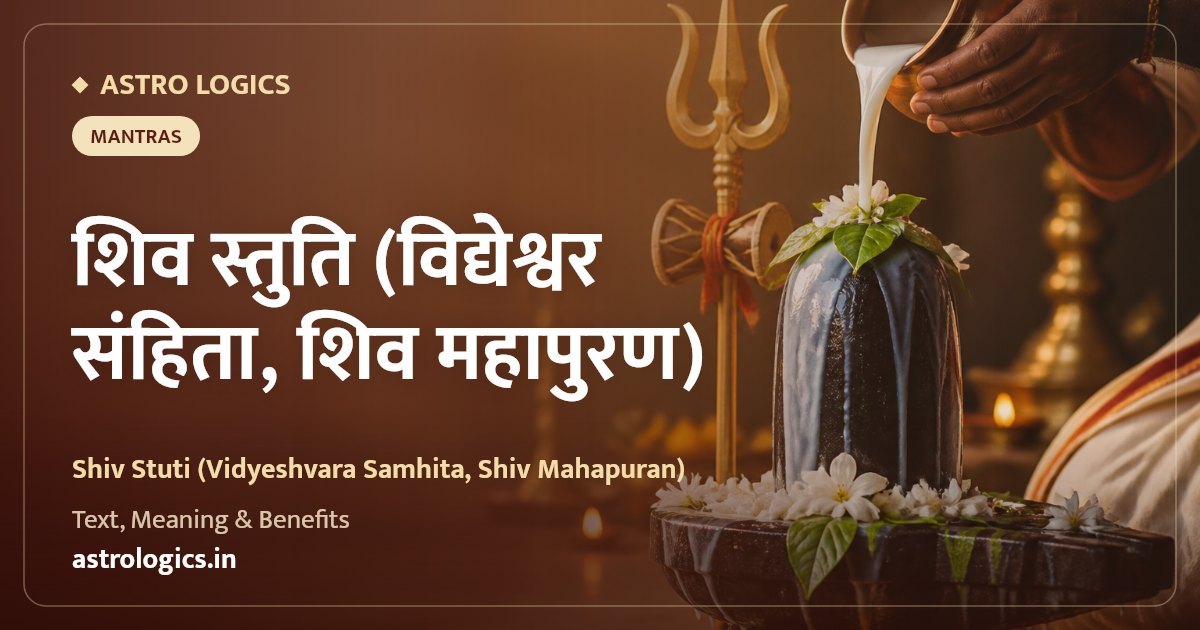
A compact obeisance that holds the whole of Shiva's nature
The Shiv Stuti beginning Om Vande Dev Umapatim may be brief, but its architecture is devotionally dense. By addressing Shiva as Umapati - husband of Uma - the hymn immediately situates him within the relational warmth of the divine couple, tempering the austere cosmic image of the ascetic with the tenderness of the beloved. The subsequent epithets bow to Shiva's many faces: as Suruguru, the teacher of the gods; as the one who wears the crescent and the river; as the lord who is both destroyer and sustainer. Each name is an invitation to contemplate a different facet of the same infinite reality, making the stuti as suitable for meditative reflection as for rhythmic chanting.
In the Jyotish tradition, Shiva's mantra practices are recommended both for Saturn (Shani) - whose karmic lessons Shiva's grace is believed to soften - and for the Moon (Chandra), who rides upon Shiva's crown and whose emotional turbulence is calmed by Shiva's serene, detached awareness. Mondays, Pradosha Vrata, and Maha Shivaratri are the ideal occasions for its recitation, though devotees in the bhakti tradition maintain that any moment of genuine longing for the divine is the right moment. Its conciseness makes it especially suitable for those beginning a Shiva sadhana, offering a complete philosophical portrait of the Lord in a form that is easy to memorise and carry through the day.