Shiv Swarnamala Stuti: Sanskrit Text, Meaning & Benefits
Shiv Swarnamala Stuti - Sanskrit Text
The Suvarnamala (Swarnamala) Stuti of Adi Shankaracharya is an akshara-mala - a "garland of letters" - in which successive verses begin with successive letters of the Sanskrit alphabet, every verse sealed by the same refrain of surrender. The popularly recited selection of verses is given below; the refrain "Samba Sadashiva Shambho Shankara, sharanam me tava charana-yugam" closes each one.
॥ श्री शिवस्वर्णमालास्तुतिः ॥
साम्ब सदाशिव शम्भो शङ्कर शरणं मे तव चरणयुगम् ॥
ईशगिरीश नरेश परेश महेश बिलेशय भूषण भो ।
साम्ब सदाशिव शम्भो शङ्कर शरणं मे तव चरणयुगम् ॥
उमया दिव्य सुमङ्गल विग्रहयालिङ्गित वामाङ्ग विभो ।
साम्ब सदाशिव शम्भो शङ्कर शरणं मे तव चरणयुगम् ॥
ऊरीकुरु मामज्ञमनाथं दूरीकुरु मे दुरितं भो ।
साम्ब सदाशिव शम्भो शङ्कर शरणं मे तव चरणयुगम् ॥
ॠषिवर मानस हंस चराचर जनन स्थिति लय कारण भो ।
साम्ब सदाशिव शम्भो शङ्कर शरणं मे तव चरणयुगम् ॥
अन्तःकरण विशुद्धिं भक्तिं च त्वयि सतीं प्रदेहि विभो ।
साम्ब सदाशिव शम्भो शङ्कर शरणं मे तव चरणयुगम् ॥
करुणावरुणालय मयि दास उदासस्तवोचितो न हि भो ।
साम्ब सदाशिव शम्भो शङ्कर शरणं मे तव चरणयुगम् ॥
जय कैलासनिवास प्रमथगणाधीश भूसुरार्चित भो ।
साम्ब सदाशिव शम्भो शङ्कर शरणं मे तव चरणयुगम् ॥
झनुतक झङ्किणु झनुतत्किट तक शब्दैर्नटसि महानट भो ।
साम्ब सदाशिव शम्भो शङ्कर शरणं मे तव चरणयुगम् ॥
धर्मस्थापन दक्ष त्र्यक्ष गुरो दक्षयज्ञशिक्षक भो ।
साम्ब सदाशिव शम्भो शङ्कर शरणं मे तव चरणयुगम् ॥
बलमारोग्यं चायुस्त्वद्गुणरुचितं चिरं प्रदेहि विभो ।
साम्ब सदाशिव शम्भो शङ्कर शरणं मे तव चरणयुगम् ॥
शर्व देव सर्वोत्तम सर्वद दुर्वृत्तगर्वहरण विभो ।
साम्ब सदाशिव शम्भो शङ्कर शरणं मे तव चरणयुगम् ॥
भगवन् भर्ग भयापह भूतपते भूतिभूषिताङ्ग विभो ।
साम्ब सदाशिव शम्भो शङ्कर शरणं मे तव चरणयुगम् ॥
षड्रिपु षडूर्मि षड्विकारहर सन्मुख षण्मुख जनक विभो ।
साम्ब सदाशिव शम्भो शङ्कर शरणं मे तव चरणयुगम् ॥
सत्यं ज्ञानमनन्तं ब्रह्मेत्येल्लक्षणलक्षित भो ।
साम्ब सदाशिव शम्भो शङ्कर शरणं मे तव चरणयुगम् ॥
हाऽहाऽहूऽहू मुख सुरगायक गीतापदान पद्य विभो ।
साम्ब सदाशिव शम्भो शङ्कर शरणं मे तव चरणयुगम् ॥
॥ इति श्रीमच्छङ्कराचार्यविरचिता शिवस्वर्णमालास्तुतिः ॥
Transliteration (Roman/IAST)
The recurring refrain is the heart of the hymn:
sāmba sadāśiva śambho śaṅkara śaraṇaṃ me tava caraṇa-yugam ||
"O Samba (Shiva with Ambika), Sadashiva, Shambhu, Shankara - your two feet are my refuge."
īśa-girīśa-nareśa-pareśa-maheśa bileśaya-bhūṣaṇa bho |
sāmba sadāśiva śambho śaṅkara śaraṇaṃ me tava caraṇa-yugam ||
umayā divya-sumaṅgala-vigrahayā-liṅgita-vāmāṅga vibho |
sāmba sadāśiva śambho śaṅkara śaraṇaṃ me tava caraṇa-yugam ||
(each successive verse opens with the next letter of the alphabet and closes with the same refrain) …
satyaṃ jñānam-anantaṃ brahmety-el-lakṣaṇa-lakṣita bho |
sāmba sadāśiva śambho śaṅkara śaraṇaṃ me tava caraṇa-yugam ||
Meaning
Each verse offers a fresh garland of epithets to Shiva and ends with the same humble surrender: "Your two feet are my refuge." Shiva is hailed as Isha, lord of the mountain, of men and of the gods, the great Lord adorned with the serpent (verse 1); as the Lord whose left side is embraced by Uma in her divinely auspicious form (verse 2). The seeker prays to be accepted though ignorant and helpless, and to have his sins driven far away (verse 3); he salutes the swan that floats on the lake of sages' minds, the cause of the birth, sustenance and dissolution of all moving and unmoving things (verse 4). He begs for inner purity and true devotion (verse 5), reminding the ocean of compassion that it does not befit him to be indifferent to his servant (verse 6). Shiva is praised as the dweller of Kailasa and lord of the Pramatha hosts (verse 7), the great cosmic dancer whose feet sound the rhythms of creation (verse 8), the three-eyed establisher of dharma who chastened Daksha's sacrifice (verse 9). The devotee asks for strength, health and a long life devoted to Shiva's virtues (verse 10). Later verses extol him as Sharva, best of gods, destroyer of the pride of the wicked (verse 11); as Bhagavan Bharga, remover of fear, lord of beings, his body smeared with ash (verse 12); as the destroyer of the six enemies, six waves and six modifications, and father of the six-faced Skanda (verse 13); as that which the Vedas mark with the words "Truth, Knowledge, Infinite, Brahman" (verse 14); and as the Lord whose deeds the celestial singers chant (verse 15).
About this Stotra
The Shiva Swarnamala (Suvarnamala) Stuti - the "golden garland of letters in praise of Shiva" - is composed by Adi Shankaracharya. It is an akshara-mala stotra, a form in which successive verses begin with the successive letters of the Sanskrit varnamala, so that the whole alphabet is woven into a single hymn of praise. Uniting profound Vedantic ideas (Shiva as "Satyam Jnanam Anantam Brahma") with the simplest expression of devotion, the hymn repeats one unforgettable refrain - Samba Sadashiva Shambho Shankara, sharanam me tava charana-yugam - turning the entire stuti into a sustained act of self-surrender (sharanagati) at the feet of Shiva.
Significance & Spiritual Benefits
The power of this stuti lies in its refrain of surrender. Where many hymns ask for specific boons, the Swarnamala Stuti asks chiefly for refuge, inner purity, true devotion, and freedom from sin and ego - though it also prays for strength, health and a long life devoted to Shiva (verse 10). Repeating "your feet are my refuge" after every verse cultivates humility and complete dependence on the Lord, which the tradition holds to be the surest path to grace. The garland of the whole alphabet symbolises offering the entirety of speech and thought to Shiva. Regular recitation is said to purify the mind, dissolve the six inner enemies (lust, anger, greed, delusion, pride and envy named in verse 13), and bring the peace of one who has placed his burdens at the Lord's feet.
Astrological Relevance
As a hymn of surrender to Shiva, the Swarnamala Stuti is a classical remedy for the most testing planetary periods. Shiva, the lord of time and dissolution, is the deity of Shani (Saturn) and the karmic nodes Rahu and Ketu; his refuge is sought during Sade Sati, Saturn and Ketu dashas, and Maha-dasha sandhi. The verse explicitly asking for "strength, health and long life" (bala, arogya, ayus) makes the hymn especially apt for strengthening a weak Lagna (ascendant) lord and a debilitated Surya (Sun), the karakas of vitality. Its prayer for inner purity and the conquest of the six enemies supports a troubled Mangala (Mars) and Budha (Mercury), while the Moon on Shiva's brow links it to mental peace. Recited on Mondays and during Pradosha, it invites Shiva's protective grace over the whole horoscope.
How to Chant (Vidhi)
Bathe and sit before a Shiva lingam or image, facing east or north. Light a lamp, offer bilva (bel) leaves, white flowers and sacred ash, and apply tripundra. Recite the verses melodiously, dwelling on the refrain "Samba Sadashiva Shambho Shankara, sharanam me tava charana-yugam," letting each repetition deepen the feeling of surrender. The hymn is well suited to group singing because of its strong, repeating refrain. Conclude with "Om Namah Shivaya" and the offering of the lamp.
Best Day & Time
Monday (Somvar) is the most auspicious day, along with the Pradosha twilight, Maha Shivaratri, and the month of Shravana. The Brahma-muhurta and the evening Pradosha hour are ideal. As a hymn of surrender it may be recited at any moment of difficulty or devotion.
Frequently Asked Questions
What does the refrain mean?
"Samba Sadashiva Shambho Shankara, sharanam me tava charana-yugam" means "O Samba (Shiva united with Ambika), Sadashiva, Shambhu, Shankara - your two feet are my refuge." It is repeated after every verse, making the whole hymn an act of surrender to Shiva.
Why is it called Swarnamala (a garland of letters)?
It is an akshara-mala stotra in which successive verses begin with successive letters of the Sanskrit alphabet, weaving the entire varnamala into a single golden "garland" of praise to Shiva.
What is the main benefit of reciting it?
Beyond worldly blessings of strength, health and long life, its chief benefit is spiritual: the repeated surrender cultivates humility, devotion and inner purity, dissolving ego and the inner enemies, and placing the devotee under the protective grace of Lord Shiva.
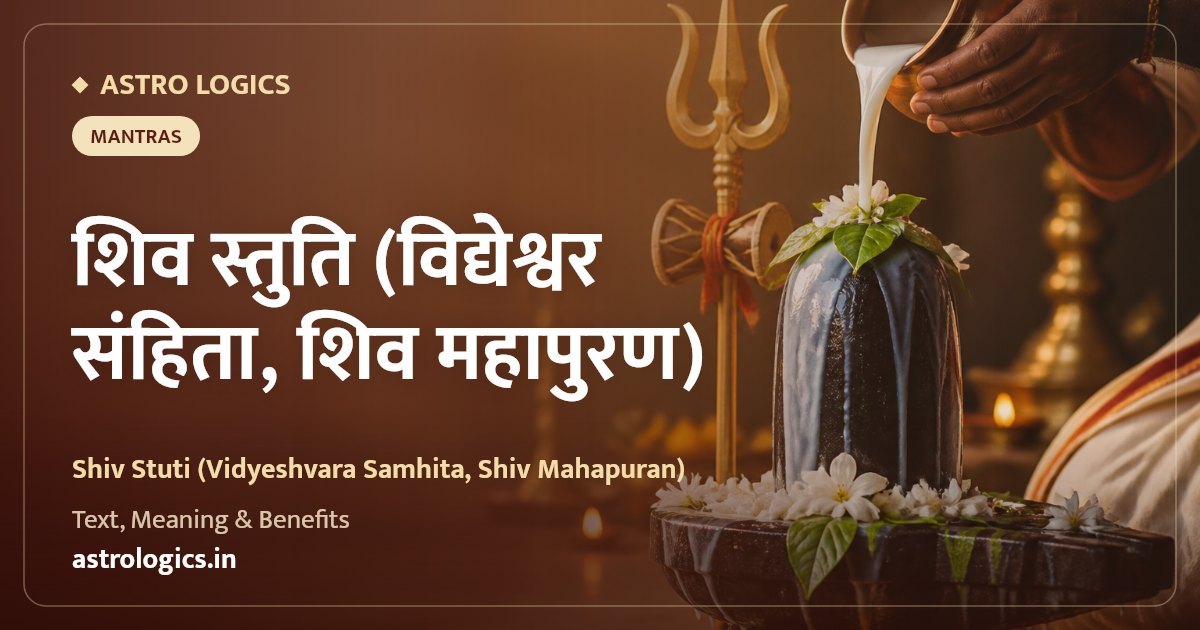
An alphabetical act of surrender at Shiva's feet
The Swarnamala Stuti - literally a 'garland of gold' - reveals the compositional genius of Adi Shankaracharya in its very architecture: each verse begins with a successive letter of the Sanskrit alphabet, turning the entire language into a garland laid at Shiva's feet. But it is the recurring refrain that carries the hymn's devotional soul: every verse ends with a surrender to Samba Sadashiva Shambho Shankara, the ever-auspicious, ever-present Lord who is both the dancer of the cosmic rhythm and the stillness at the heart of all movement. This double movement - eloquent verse followed by simple surrender - models precisely the spiritual path Shankaracharya himself taught: the mind rises through understanding and poetry, then dissolves into the wordless recognition of Shiva as the ground of all being. The Stuti thus works simultaneously as intellectual engagement and as pure bhakti.
Shiva in his aspect as Sadashiva - the eternally auspicious - is understood in the tradition as the one who grants liberation, and the Swarnamala Stuti is therefore especially cherished by those engaged in serious sadhana rather than merely petitionary worship. It is recited with particular fervour on Shivaratri nights, on Pradosha (the twilight of the thirteenth lunar day), and on Mondays throughout the lunar month. Devotees believe that approaching the hymn not simply as a text to be recited but as a living act of surrender - each verse a fresh offering - gradually dissolves the ego's sense of separation and brings the worshipper into genuine proximity with the grace of Mahadeva.