Shri Shiv Mangalashtakam: Eight Verses of Auspiciousness to Lord Shiva
Shri Shiv Mangalashtakam - Sanskrit Text
भवाय चन्द्रचूडाय निर्गुणाय गुणात्मने ।
कालकालाय रुद्राय नीलग्रीवाय मङ्गलम् ॥१॥
वृषारूढाय भीमाय व्याघ्रचर्माम्बराय च ।
पशूनां पतये तुभ्यं गौरीकान्ताय मङ्गलम् ॥२॥
भस्मोद्धूलितदेहाय व्यालयज्ञोपवीतिने ।
रुद्राक्षमालाभूषाय व्योमकेशाय मङ्गलम् ॥३॥
सूर्यचन्द्राग्निनेत्राय नमः कैलासवासिने ।
सच्चिदानन्दरूपाय प्रमथेशाय मङ्गलम् ॥४॥
मृत्युञ्जयाय साम्बाय सृष्टिस्थित्यन्तकारिणे ।
त्र्यम्बकाय सुशान्ताय त्रिलोकेशाय मङ्गलम् ॥५॥
गङ्गाधराय सोमाय नमो हरिहरात्मने ।
उग्राय त्रिपुरघ्नाय वामदेवाय मङ्गलम् ॥६॥
सद्योजाताय शर्वाय दिव्यज्ञानप्रदायिने ।
ईशानाय नमस्तुभ्यं पञ्चवक्त्राय मङ्गलम् ॥७॥
सदाशिवस्वरूपाय नमस्तत्पुरुषाय च ।
अघोराय च घोराय महादेवाय मङ्गलम् ॥८॥
मङ्गलाष्टकमेतद्वै शम्भोर्यः कीर्तयेद्दिने ।
तस्य मृत्युभयं नास्ति रोगपीडाभयं तथा ॥९॥
Transliteration (Roman/IAST)
bhavāya candracūḍāya nirguṇāya guṇātmane |
kālakālāya rudrāya nīlagrīvāya maṅgalam ||1||
vṛṣārūḍhāya bhīmāya vyāghra-carmāmbarāya ca |
paśūnāṃ pataye tubhyaṃ gaurī-kāntāya maṅgalam ||2||
(Each of the eight verses closes with "maṅgalam" - auspiciousness - to Shiva in one of his glorious forms.)
mṛtyuñjayāya sāmbāya sṛṣṭi-sthity-anta-kāriṇe |
tryambakāya suśāntāya trilokeśāya maṅgalam ||5||
maṅgalāṣṭakam-etad vai śambhor-yaḥ kīrtayed dine |
tasya mṛtyu-bhayaṃ nāsti roga-pīḍā-bhayaṃ tathā ||9||
Meaning
The hymn calls down mangalam (auspiciousness, blessing) upon Lord Shiva in form after form:
Verse 1: Auspiciousness to Bhava (source of existence), the moon-crested, the attributeless yet the soul of all qualities, the Death of death (Kalakala), Rudra, the blue-throated one.
Verse 2: Auspiciousness to the rider of the bull, the formidable Bhima, clothed in tiger-skin, the Lord of all creatures (Pashupati), the beloved of Gauri.
Verse 3: Auspiciousness to him whose body is smeared with ash, who wears a serpent as the sacred thread, adorned with the rudraksha garland, the sky-haired one (Vyomakesha).
Verse 4: Salutation and auspiciousness to him whose three eyes are the sun, moon and fire, the dweller of Kailasa, the form of Sat-Chit-Ananda, the Lord of the Pramathas.
Verse 5: Auspiciousness to Mrityunjaya (conqueror of death), Samba (with the Mother), the doer of creation, sustenance and dissolution, the three-eyed, perfectly serene Lord of the three worlds.
Verse 6: Auspiciousness to the bearer of the Ganga, the moon-adorned, the very being of Hari and Hara, the fierce slayer of Tripura, Vamadeva.
Verses 7-8: Auspiciousness to Sadyojata, Sharva, the giver of divine knowledge, Ishana, the five-faced one; to the very form of Sadashiva, to Tatpurusha, to Aghora and Ghora, the great God Mahadeva. (These verses invoke the five faces and five Brahma-mantras of Shiva - Sadyojata, Vamadeva, Aghora, Tatpurusha and Ishana.)
Phalashruti: Whoever recites this Mangalashtakam of Shambhu daily has no fear of death, nor any fear of disease and affliction.
About this Stotra
Shri Shiv Mangalashtakam is an eight-verse "mangala" hymn - a form whose purpose is to invoke blessing and auspiciousness. Where most stotras praise or petition, a mangalashtakam pronounces mangalam ("may there be auspiciousness") upon the deity in each verse, and that auspiciousness flows back to the reciter and the world. Each of the eight verses gathers a cluster of Shiva's names and forms - the moon-crested Chandrachuda, the blue-throated Nilakantha, the bull-riding Pashupati, the ash-smeared Vyomakesha, the three-eyed Mrityunjaya, the Ganga-bearing Gangadhara, and the five-faced Sadashiva with his five Brahma-mantras (Sadyojata, Vamadeva, Aghora, Tatpurusha, Ishana). The closing verse gives a clear phalashruti. It is widely recited in daily Shiva worship and especially on Mondays, Pradosha and Maha Shivaratri.
Significance & Spiritual Benefits
The hymn's special power lies in its phalashruti: daily recitation is said to remove the fear of death and the fear of disease and affliction. This makes it a treasured prayer for health, protection and a peaceful, fearless mind - fitting, since it repeatedly names Shiva as Mrityunjaya, the conqueror of death, and Kalakala, the death of death itself. By invoking auspiciousness upon all of Shiva's forms, the reciter is steeped in mangala - the atmosphere of blessing - which is held to bring well-being, serenity and the dissolving of inauspicious influences. The dense garland of names also serves as a compact meditation on the whole of Shiva's iconography and theology, from the formless Absolute to the five-faced Sadashiva.
Astrological Relevance
Lord Shiva is the deity invoked in jyotisha for Shani (Saturn), the great planet of karma, discipline, longevity and hardship, and his worship is the foremost remedy during Sade Sati, the dhaiyya, and difficult Saturn periods and transits. This Mangalashtakam is especially relevant because its phalashruti directly addresses freedom from the fear of death and disease - concerns governed by the 8th house (longevity, chronic illness) and the lagna and its lord. The names Mrityunjaya and Kalakala make it a natural companion to the Mahamrityunjaya practice for the protection of health and life, useful where the chart shows threats to longevity or a malefic dasha affecting vitality. As a hymn of pure auspiciousness, it is also recited to counter inauspicious yogas, to pacify malefic planets generally, and to invite mangala before new undertakings. Reciting it on Mondays (Shiva's and the Moon's day) supports a steady, calm mind.
How to Chant (Vidhi)
Bathe and sit before a Shiva linga or image facing east or north. Light a lamp and offer bilva (bel) leaves, white flowers, and water or milk for abhisheka. Begin with ॐ नमः शिवाय, then recite the eight verses with devotion, dwelling on the word "mangalam," and finish with the phalashruti. The text recommends daily recitation ("yah kirtayed dine"). A calm, reverent mind and ritual purity enhance the practice; many devotees pair it with bilva-archana or Rudrabhisheka.
Best Day & Time
Monday (Shiva's and the Moon's day), every Pradosha (the 13th tithi at dusk), the Mondays of the month of Shravana, and Maha Shivaratri are the most auspicious occasions. The pradosha-kala (twilight) and the early-morning Brahma muhurta are the ideal times, though the phalashruti commends daily recitation.
Frequently Asked Questions
What is a Mangalashtakam?
A Mangalashtakam is an eight-verse hymn that invokes mangalam - auspiciousness or blessing - upon a deity in each verse. Rather than petitioning, it pronounces blessing, and that auspiciousness is believed to return to the reciter and the world.
What benefit does the Shiv Mangalashtakam promise?
Its closing verse states that one who recites it daily has no fear of death (mrityu-bhaya) and no fear of disease and affliction (roga-pida-bhaya), making it a cherished prayer for health, longevity and fearlessness.
What are the five names in verses 7-8?
Sadyojata, Vamadeva, Aghora, Tatpurusha and Ishana are the five faces of Sadashiva and the five Brahma-mantras of the Shaiva tradition, representing the five aspects and elements through which Shiva manifests the cosmos.
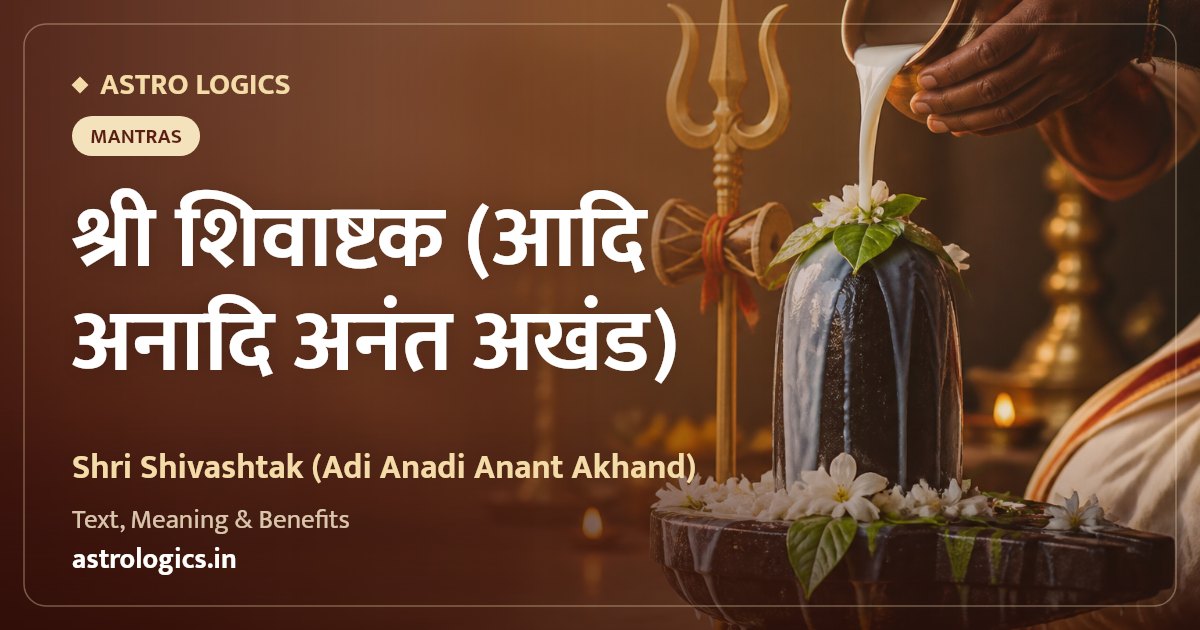
Invoking auspiciousness in all of Shiva's radiant forms
The Shiv Mangalashtakam belongs to a genre of hymns devoted entirely to the invocation of mangalam - divine auspiciousness - rather than to narrative praise alone. Each of its eight verses calls upon a specific form or attribute of Shiva: the moon-crested Chandrachuda whose grace cools suffering; the Mrityunjaya whose victory over death offers the greatest solace; the Gangadhara who receives and transforms even what is overwhelming; the blue-throated Nilakantha who transmutes poison for the sake of all beings. This multiplicity within a single hymn makes it especially powerful as a daily invocation, as the devotee moves through Shiva's moods and meanings rather than resting on a single image.
Mondays and Pradosha days (the thirteenth tithi of each fortnight) are the most auspicious occasions for this ashtakam, and it is frequently chanted at the conclusion of Shiva puja or abhishekam. In the Jyotish tradition, Shani (Saturn) and Mangal (Mars) are both traditionally pacified through sincere Shiva sadhana; devotees believe this hymn, with its sustained focus on Mrityunjaya and protection from untimely harm, is particularly supportive for those navigating difficult Saturn periods or the Sade Sati. The warmth of this hymn lies in its reminder that the terrifying and the auspicious are not opposites in Shiva's world; they are two faces of the same boundless grace.