Vaishno Mata Aarti – Jai Vaishnavi Mata Lyrics, Meaning & Blessings
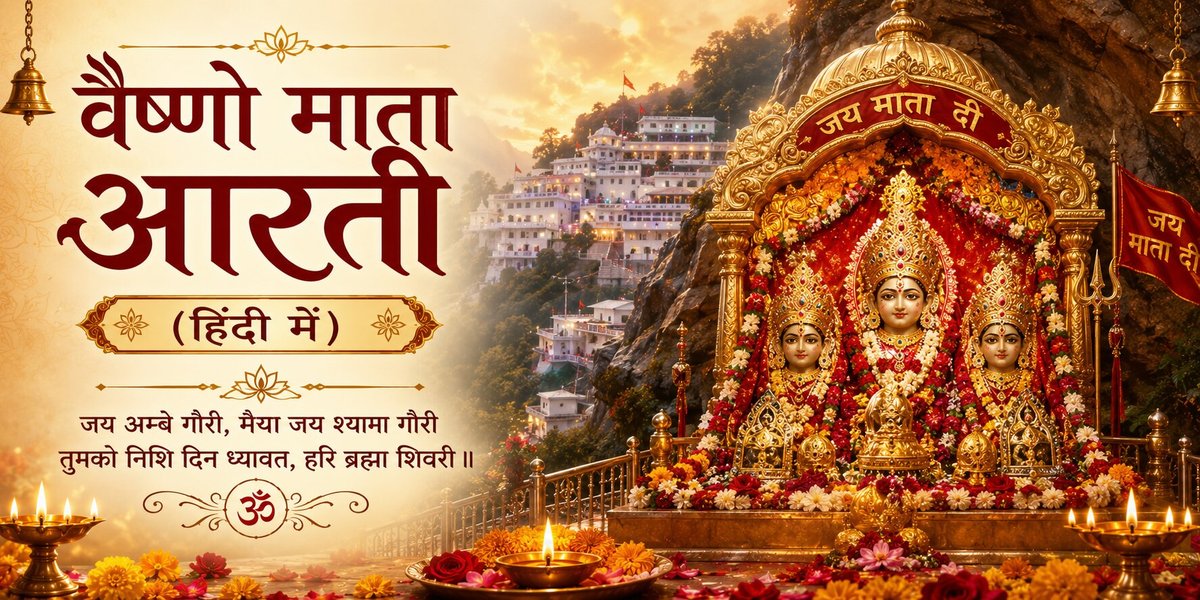
The living grace of Vaishno Devi: devotion born of pilgrimage
Maa Vaishno Devi is among the most beloved and widely visited Shakti shrines in India, nestled in the Trikuta Hills of the Jammu region, and the aarti Jai Vaishnavi Mata carries the warmth and devotional intensity of a tradition sustained by millions of pilgrims over centuries. The deity is revered as a manifestation of the trinity of Maha Kali, Maha Lakshmi, and Maha Saraswati combined in three sacred pindis within the natural cave shrine, making her worship an honouring of Shakti in her most complete form. The mood this aarti evokes is one of joyful, eager longing -- the bhakta's heart moving toward the Mother like a pilgrim ascending the mountain path with a lamp in hand.
Devotees sing this aarti during the daily puja at home shrines, and it is especially resounding during Navratri, when the spiritual connection to Vaishno Devi is believed to be most potent and the flow of pilgrims to the Trikuta shrine swells enormously. The aarti is also a natural accompaniment to any Mata ki Chowki, the devotional gathering through which communities in North India honour the goddess together through the night. In the devotional tradition, reciting this aarti with sincerity is considered an act of virtual pilgrimage -- a way of touching the grace of Vaishno Devi even from the furthest homes, affirming that the Mother's presence is never confined to geography alone.
Vaishno Mata Aarti Lyrics (हिंदी में)
जय वैष्णवी माता, मैया जय वैष्णवी माता।
हाथ जोड़ तेरे आगे, आरती मैं गाता॥
शीश पे छत्र विराजे, मूरतिया प्यारी।
गंगा बहती चरनन, ज्योति जगे न्यारी॥
जय वैष्णवी माता, मैया जय वैष्णवी माता।
ब्रह्मा वेद पढ़े नित द्वारे, शंकर ध्यान धरे।
सेवक चंवर डुलावत, नारद नृत्य करे॥
सुन्दर गुफा तुम्हारी, मन को अति भावे।
बार-बार देखन को, ऐ माँ मन चावे॥
जय वैष्णवी माता, मैया जय वैष्णवी माता।
भवन पे झण्डे झूलें, घंटा ध्वनि बाजे।
ऊँचा पर्वत तेरा, माता प्रिय लागे॥
पान सुपारी ध्वजा नारियल, भेंट पुष्प मेवा।
दास खड़े चरणों में, दर्शन दो देवा॥
जय वैष्णवी माता, मैया जय वैष्णवी माता।
जो जन निश्चय करके, द्वार तेरे आवे।
उसकी इच्छा पूरण, माता हो जावे॥
इतनी स्तुति निश-दिन, जो नर भी गावे।
कहते सेवक ध्यानू, सुख सम्पत्ति पावे॥
जय वैष्णवी माता, मैया जय वैष्णवी माता।
हाथ जोड़ तेरे आगे, आरती मैं गाता॥
Vaishno Mata Aarti – Transliteration (English)
Jai Vaishnavi Maata, Maiya Jai Vaishnavi Maata.
Haath jod tere aage, aarti main gaata.
Sheesh pe chhatra viraaje, mooratiya pyaari.
Ganga bahati charanan, jyoti jage nyaari.
Jai Vaishnavi Maata, Maiya Jai Vaishnavi Maata.
Brahma ved padhe nit dwaare, Shankar dhyaan dhare.
Sevak chanvar dulaavat, Narad nritya kare.
Sundar gufa tumhaari, man ko ati bhaave.
Baar-baar dekhan ko, ai Maan man chaave.
Jai Vaishnavi Maata, Maiya Jai Vaishnavi Maata.
Bhavan pe jhande jhulen, ghanta dhwani baaje.
Ooncha parvat tera, Maata priya laage.
Paan supaari dhwaja naariyal, bhent pushp meva.
Das khade charanon mein, darshan do deva.
Jai Vaishnavi Maata, Maiya Jai Vaishnavi Maata.
Jo jan nishchay karke, dwaar tere aave.
Uski ichchha pooaran, Maata ho jaave.
Itni stuti nish-din, jo nar bhi gaave.
Kahate sevak Dhyaanu, sukh sampatti paave.
Jai Vaishnavi Maata, Maiya Jai Vaishnavi Maata.
Haath jod tere aage, aarti main gaata.
Meaning & Significance
This aarti transports the mind instantly to the cool, torch-lit cave of Vaishno Devi, nestled in the Trikuta mountains of Jammu and Kashmir. Every verse paints a scene: the sacred canopy over the goddess's serene form, the Ganga flowing from her feet, Brahma reciting the Vedas at her threshold, Narada dancing in joyful devotion, flags fluttering in the mountain wind. The aarti distills the experience of the yatra (pilgrimage) itself into a few luminous lines, allowing devotees who have never undertaken the physical journey to dwell at the goddess's feet in spirit. The closing verse attributes the composition to the devotee Dhyanu, reflecting the long tradition of personal testimony in Shakta devotional poetry.
About Vaishno Devi
Mata Vaishno Devi is a manifestation of the Adi Shakti venerated as the combined form of Maha Saraswati, Maha Lakshmi, and Maha Kali - the three primordial aspects of the Divine Mother. Her primary shrine, located at 5,200 feet above sea level in the Trikuta range, is one of the most visited pilgrimage sites in all of India, receiving millions of devotees annually. According to tradition, the goddess lived here as an ascetic princess named Vaishnavi before taking her permanent abode in the cave where she is now worshipped in the form of three natural rock formations (pindis) rather than a sculpted image. The pilgrimage route through Katra, Banganga, Ardh Kuwari, and the holy cave is considered a complete spiritual journey in its own right.
Benefits of Reciting the Vaishno Mata Aarti
- Evokes the blessing of all three divine shaktis - Saraswati, Lakshmi, and Kali - simultaneously, since Vaishno Devi embodies their combined power.
- Fulfils sincere wishes and resolves longstanding problems; the aarti explicitly states that whoever approaches with unwavering faith receives complete fulfilment.
- Brings peace, prosperity, and happiness (sukh sampatti) to those who recite it daily, as promised in the closing verse.
- Connects distant devotees to the energy of the sacred Trikuta cave shrine, enabling the inner experience of yatra without the physical journey.
- Purifies the home environment and invites auspicious divine energy when performed in the morning or evening.
- Strengthens resolve and faith during difficult periods of life, reminding the devotee that the Mother stands ready to help all who seek her sincerely.
How to Perform the Aarti (Pooja Vidhi)
- Clean the puja space and place a framed image or idol of Mata Vaishno Devi, ideally facing east, on a red cloth decorated with flowers.
- Light a diya with pure ghee and place fresh marigold or lotus flowers before the image; offer a small red chunri (veil) as is traditional at Vaishno Devi's shrine.
- Hold the aarti thali containing the lit diya and rotate it seven times clockwise before the image while singing the aarti or playing a recording.
- Ring the puja bell with the left hand throughout; the bells of the Vaishno Devi shrine are a defining sonic element of devotion to this goddess.
- Offer a coconut, betel leaves, and dried fruits as mentioned in the aarti itself - simple, wholesome gifts that reflect mountain pilgrimage traditions.
- Close with prostration, a moment of silent prayer in the mind, and distribution of prasad (coconut pieces, mishri, or fruit) to all present.
Best Day & Time to Recite
Navratri (both Chaitra and Sharad) is the most celebrated occasion for this aarti, and at the Vaishno Devi shrine itself, Navratri draws millions of pilgrims. In daily practice, Friday is the most auspicious day for reciting the aarti, as Friday is associated with Goddess Lakshmi-Shakti energies. The morning Brahma muhurta or the evening at sunset are the recommended times. On Ashtami (the eighth lunar day) and during any personal vow or sankalpa made to Mata Rani, this aarti forms the core act of devotion.
Frequently Asked Questions
Who is Dhyanu Bhagat mentioned at the end of the aarti?
Dhyanu Bhagat is a legendary devotee from the village of Hansali in Himachal Pradesh who is said to have been a fearless and devoted pilgrim of Mata Vaishno Devi. Several aartis and devotional songs dedicated to various North Indian goddesses attribute their composition to this saintly figure, reflecting the tradition of humble devotion-poetry composed in the first person by an archetypal bhakta (devotee).
Is Vaishno Devi related to Vaishnavi, a manifestation of Vishnu's shakti?
Yes. The name Vaishnavi literally means she who belongs to Vishnu or she who is Vishnu's power, reflecting the goddess's identity as Maha Lakshmi and Adi Shakti simultaneously. The Devi Bhagavata Purana and local traditions describe Mata Vaishnavi as having received blessings from both Lord Rama and Lord Vishnu, establishing her as a goddess who bridges Shaiva, Vaishnava, and Shakta streams of devotion.
Can I perform Vaishno Mata aarti at home if I cannot go on pilgrimage?
Home worship of Mata Vaishno Devi is entirely valid and widely practised. The aarti itself was composed precisely to enable devotees to experience the darshan (divine vision) of the goddess wherever they are. Keeping a framed image of the cave pindis and performing the aarti sincerely is regarded as equivalent in spirit to making the physical yatra, though the latter is also encouraged whenever circumstances allow.